keywords

!Garib (2) Acacia karroo (1) afroedura (1) agriculture (1) algae (1) all that crawlith (2) amphibians (3) anthrax (1) aposmatic colouration (2) arachnid (4) arthropod (1) Baobab (3) bat (2) Bat Migration (1) biodiversity (15) bipedalism (1) birds (4) Black Mamba (2) Botswana (1) brumation (1) buffalo (1) Bush Meat (1) bushveld (4) Cambrian (1) Carbon Cycle (1) Central Africa (1) Chameleon (1) chemical erosion (1) coastal forest (1) cocoon (1) coevolution (2) colony (1) conservation (6) consume (1) cosmos (1) cultivation (1) darkling (1) death (3) decomposer (1) Desert (1) Devonian (1) diapsid (2) domestication (1) drought (1) Durban (2) Ecology (9) elapid (2) elephant (1) endemic (2) Energy Cycle (1) eugene marais (2) evolution (2) eye spots (1) fire (2) flash colouration (1) flat dog (1) flower (1) Forest (1) Forest Cobra (1) frog (3) fungus (1) gecko (3) Gondwana (1) Grass (3) herpetology (3) hibernation (1) human culture (8) hyrax (2) identification (3) imago (1) impact crater (1) Inanda (1) Inquiline (1) insect (5) Johannesburg (6) Kalahari (1) Kasanka (1) katydid (3) Klipriviersberg (2) koppies (1) Lajuma (1) larva (1) Leopard (1) Lepidoptera (1) Limpopo (3) Limpopo Valley (1) lowveld (2) Medike Mountain Sanctuary (3) meteorite (1) mimicry (5) mining (2) Miombo (1) mite (1) money (1) moult (1) naja annulifera (1) Namakwa (2) namaqualand (1) natural history (2) nature (7) Neolithic (1) neurotoxic (1) Nietzsche (1) nocturnal (2) Northern Cape (1) nutrient cycle (2) Owl (1) Pafuri (1) Paleoanthropology (1) parasite (2) parasitic (1) pathogenic (1) photosynthesis (1) pioneer (1) Poaching (1) poisoning (1) pollination (1) Predetor and Primate Project (1) raptor (1) reptile (5) reptiles (6) Richtersveld (1) rust (1) savanna (6) scorpion (4) Scorpions (1) selati river (1) skink (1) Snake (7) Snake Snake Snake (2) snouted cobra (1) solifuge (2) South Africa (1) southern africa (1) Soutpansberg (4) Soutpansberg Centre for Biodiversity and Conservation (3) spider (3) spoor (1) spore (1) stone age (1) stridulate (2) Suikerbosrand (1) summer (3) swarm (2) taxonomy (1) Urban Birds Johannesburg (3) Urban ecology (4) Urban Forest (2) Vachellia karroo (1) Vachellia robusta (1) Vachellia xanthophloea (1) Venda (1) venom (1) venus (1) Vhembe Biosphere Reserve (4) waterberg mountains (2) weathering (1) weeds (1) Welgevonden (1) wetland (2) Wheat (1) winter (2) Zambia (1) zoonotic (1)

Blog Archive

Showing posts with label Urban Birds Johannesburg. Show all posts

Saturday, March 1, 2014

Jeppe – Inner-city Johannesburg Biodiversity


Photos generously supplied by Francis Burger.

A Garden Orb-web Spider (Argiope australis). This spider was capitalising on the many flies of the city.


When I think of a city urban space in Johannesburg, I see concrete, tar roads, steel and a lot dirt, filth and stagnant water. The life I would associate with these spaces would consist of street trees (sterile imports from the northern hemisphere), Pigeons (properly Columbo livia, a cosmopolitan species from the northern hemisphere), the odd house sparrow, rats and cockroaches (all three also imports from the northern hemisphere. My skepticism concerning the ability of nature to be robust enough to not only cling on in the city, but actually thrive, was challenged this February while working with artist Francis Burger on a project working in the city exploring biodiversity. 

A sidewalk and a verge in Jeppe. All available land is used by vegetative life. The competition for space on the verge is evident by the density of the growth. Some plants have taken to growing in the gaps in the asphalt and tar.


This small beetle was found on some grass growing on the verge. Even the smallest areas should not be underestimated as habitats for organisms.

During two qualitative sessions, we walked the streets and explores empty lots between buildings to try and build up an as comprehensive species list, kind of like a snapshot, of what is out there in the city. Our idea at first was to concentrate on grasses, but we soon found ourselves unable to ignore the rich forb diversity. As we progressed we added insects and birds as well as a reptile. After reviewing the findings I really had to face up to my prejudices of what I thought these kinds of environments are able to support.


Three species of beetles from the Coccinellinae sub-family. Many of these beetles are predatory and eat aphids.
Astylus atromaculatus – Spotted Maize Beetle. Native to South America this is a major agricultural pest.

Grass
Johannesburg is often referred to as the largest man-made forest in the world. Many trees were planted in the early days of the city for mining timber. The forest is here and it has changed the environment. In many ways it is a good thing, but Johannesburg should actually be grassland. This can be seen wherever trees and land has been cleared; the grass just comes up.

Inflorescence of Hyparrhenia hirta. An important grass for thatching. Some people were busy harvesting the very grass pictured here.
Chloris pycnothrix or Spider-web Grass.
Eragrostis curvula.
 One of the most amazing things about the growth of grass in the city is that it tries to colonise any bit of ground it gets its seeds into. Grass was found growing on pavements, between the pavers and in some areas in the middle of the road. The ecological role of grass as a weathering agent can clearly be seen. Everywhere it appears to be forcing cracks in the surface of the city open for more plants to get in and continue the process. 
Grass growing in the road. This grass will increase the gap that is already present and allow more organisms a space in what was once an inhabitable surface.

Aliens vegetation and their ecological roles

Cannabis sativa and  Amaranthus hybridus. Both of these plants are important in human culture. Here they are playing the role of pioneer species.
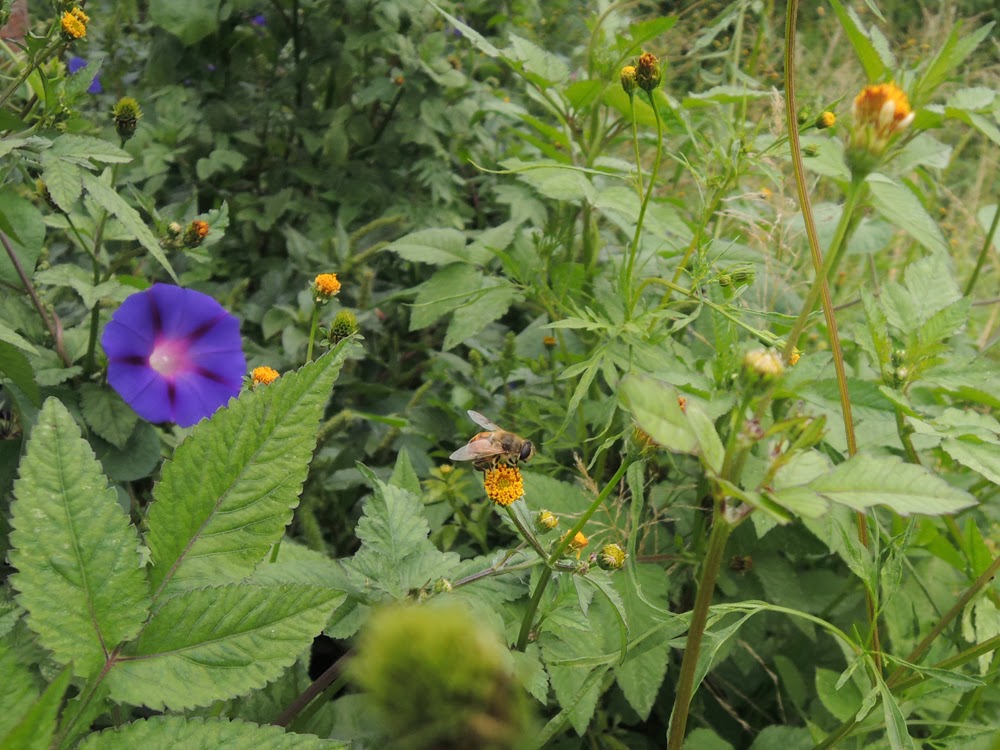
Here there are three dominant pioneer species: Bidens pilosa (Black Jacks), Tagetes minuta (Khaki Bos) and Ipomoea purpurea (Morning Glory).
 Wherever one looks in the city, the ratio between indigenous plants and alien plants is skewed in favour of the aliens. This is to be expected as these alien plants are supported by human activities and they are among the most robust plants out there. These aliens are often found growing in very trying conditions and usually unaffected by parasites and natural enemies as they have evolved in a different ecological climate. In addition to these factors the alien plants that are dominating growth areas are usually very fast growing and spread very easily. 

Cuscuta sp. – Dodder is a fascinating, yet very destructive weed. The plant is parasitic and wraps itself around other plants while disconnecting itself from the ground and feeding directly off its hosts. The plant is yellow and this is because it does not even produce its own chlorophyll for photosynthesis.
Bidens pilosa and Ipomoea purpurea, two South American species growing together.
Even though many of these plants are hated and seen as weeds that need to be eradicated, they do serve a very important purpose in the greater ecological scheme of things: these are the pioneers. This means they are the first plants to colonise a piece of land that has been disturbed. They often have roots that have nitrogen-fixing bacterial nodes on them and these strengthen the soil. The pioneer species make way for secondary succession to take place and after a few years their numbers will decline and different plants will replace them. In the case of what was observed in Johannesburg, the pioneers were mostly Tagetes minuta (Khaki Bos) and Bidens pilosa (Black Jack).


Trachylepis punctatissima – Speckled Rock Skink basking.
Lizards!
I was very pleased to find reptiles in the city. These were represented by Speckled Rock Skinks (Trachylepis punctatissima). These skinks are very robust and indicate that there is not an overuse of insecticides and they also indicate a low population of cats, which usually decimate their populations. At least eleven individuals were observed and there may be as many as triple that amount that was not seen. 

Another Speckled Rock Skink, this one is resting on a strange arrangement of bricks and wire suspended from the ground.

Birds
Birds are a good indication of the state of an environment. This is because they are not restricted by barriers that are faced by terrestrial animals, they can leave and enter areas as they need to. Although the amount of birds in the area is very low, it was higher than I had expected it to be. But when compared to a preserved site in the same city, the species diversity is very low. In the Klipriviersberg Nature Reserve for example, I could get a list of 50 birds on an average day, my list for Jeppe for was 14 birds and some fly-overs. Below is the bird list in order of recording:

Tawny-flanked Prinia, Grey Go-away Bird, Cape Turtle Dove, Laughing Dove, Speckled Pigeon, Rock Dove, Indian Myna, Cape Glossy Starling, Cape Sparrow, House Sparrow, Karroo Thrush, Village Weaver, Grey Heron (fly-over), Green Wood-hoopoe, White Stork (fly-over), Reed Cormorant (fly-over), Barn Swallow and Little Swift.

Rats and beetles 

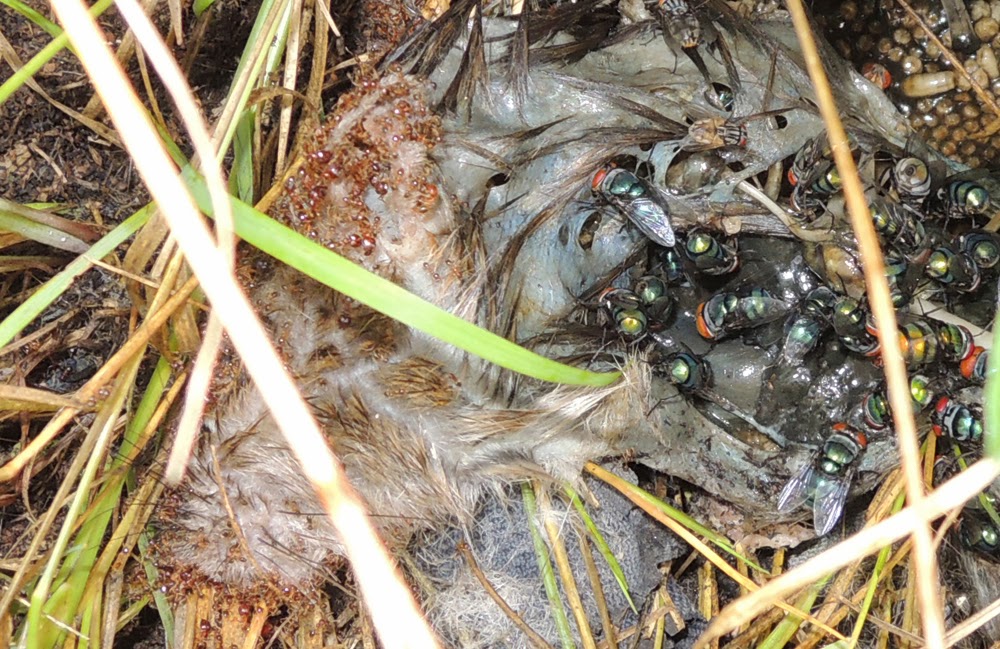
Walking in town and looking in the growth of pavements and in gutters for signs of life one finds many dead rats. In any city rats are very successful and Johannesburg is no exception. Everywhere there were rat corpses in various stages of decomposition, most of them poisoned and some killed in the road by vehicles (although being killed by a car could be indirectly linked to being poisoned as the toxins often change the rats behaviors making them more susceptible to being ‘caught out’ in the open.

The investigation of the rat’s decomposing corpses revealed an ecosystem on a small scale. Dermestidae beetles were found on the bodies and so were flies (Calliphoridae) and their larvae. Feeding on the larvae were hister beetles (Histeridae). The smell of bacteria was also present. These organisms fulfill a very important role in the decomposition process. Most people become queasy when confronted with a carcass blooming with flies and maggots, but if those people could imagine a world without flies and maggots they would feel far more sick.

Looking at how these species are able to survive in what would seem to be adverse situations, I cant imagine what kind of animals would be able to live in a city that provides some kind of ecological support structures. Imagine rooftop gardens with locally indigenous plants, massive containers with grass growing in them and ponds. My vision is one of islands of natural vegetation where insects and birds can flourish. The amount of diversity that can be attracted in such a scenario would be astounding. We are a long way from that vision, but I feel the first step in that direction is to become more aware of locally indigenous life and try and cultivate plants that are locally indigenous to encourage organisms to make our cities their homes too.

Friday, June 28, 2013

Spotted Eagle-Owls in Johannesburg


Spotted Eagle-Owl, Bubo africanus, photographed in Johannesburg.


The Spotted Eagle-Owl, Bubo africanus, is one of the few raptor species that can be commonly seen in urban and suburban Johannesburg. Its mournful hooting is a delight to some suburbanites, though there are also those who believe the owl to be a bad omen. In 2012 many owls were released into a rat-infested area as part of a project aimed at descreasing the rodent population. The project was eventually scrapped due to these superstitious beliefs.[1] People killed the owls because they were afraid of them.[2] Another great killer of owls is their inadvertent poisoning through poisoned rodents. [3] Yet despite these challenges, the Spotted Eagle-Owl is still relatively common in Johannesburg and can be classified as successful.


Spotted Eagle-Owl, Bubo africanus, photographed in Yoeville, Johannesburg. Note the Grey Go-away Bird mobbing the owl. Image courtesy of Francis Burger. 

The horned tufts on the owl have been suggested to be an evolutionary adaption to aiding in the animals camouflage by breaking the owl’s outline. Another theory on the functional purpose of the 'horns' is that they aid in visual communication between owls.[4] There is also an interesting theory that was put forward by a Norwegian study of eagle-owls in Europe, which identifies the “ear tufts” as a mimicry of mammalian carnivores. [5] This theory ventures that the ear tufts mimic facial patterns of potential predators in Europe such as the lynx, fox and marten. “In ‘face to face’ encounters they suggest that a specialised aggressive facial expression on the part of the owl may cause it’s potential ‘look-alike’ predator to withdraw”. In an African context the same could apply for predators filling the niche of the owl's European predators: think about the Caracal, Jackal, Serval and any other mammalian predator of that size. Then consider how cat-like the owl's silhouette is when seen on a roof or wall at night.

The ear tufts on this Spotted Eagle-Owl may be a mimicry modeled on potential mammalian predators.
What I like about this theory is that it makes one think of owls as vulnerable to predation.  Thus the theory also fits seamlessly with the theory that the ear tufts evolved for camouflage. Another thing that these theories force one to think about is the evolutionary path that owls took. Many people assume that owls are 'more or less' nocturnal eagles and that they share a common ancestry with eagles and other Falconiformes. Owls actually share an ancestry with the cryptic and nocturnal order of Caprimulgiformes, which includes nightjars. 

Once one begins to think of owls in this way it becomes quite easy to imagine the journey taken by little, nocturnal, night-jar like birds, slowly changing into owls: the more upright stature to be camouflaged against tree trunks, the development of talons and a flesh tearing beak to consume larger and stronger prey, and then slowly the development of ear tufts and an increase in size to aid in camouflage and deter predators of the mammalian variety through an interesting tactic of mimicry that mirrors the potential predators. 


[1] http://www.joburg.org.za/index.php?option=com_content&id=7846:owls-take-flight-in-alex&Itemid=192

[2] The owls were kept in a feeding box at a local high school for 21 days and released to hunt the rats. Bright idea, but the community killed the owls for superstitious reasons (http://www.sowetanlive.co.za/news/2013/04/18/all-they-need-in-alexandra-township-is-the-pied-piper-of-hamelin).

[3] Owls may be paralysed or killed after eating rodents poisoned by certain rodenticides. Poisoned rats and mice, whether dead or moving slowly as a result of being poisoned, are easier for owls to catch. Thus owls will eat more of these, and accumulate a large dose of poison (http://deltaenviro.org.za/resources/envirofacts/raptors.html).

[4] Carnaby, T. 2008. Beat about the Bush: Birds. Jacana Media: Johannesburg (pg 472-473).


[5] I was made aware of this theory in Peter Steyn’s book on owls. Steyn, P. 1984. A Delight of Owls: African Owls Observed. David Philip: Cape Town (pg 90).

Saturday, March 16, 2013

Proliferation of Specific Birds and Animals in the Johannesburg Area


Johannesburg’s environment has changed substantially from a Moist Highveld Grassland Biome into an ‘Urban Forest’ made up of roughly ten million trees.[1] To get an idea of what the terrain in Johannesburg must have looked like in the past one could look at the Melville Koppies Nature Reserve in Central Johannesburg and Klipriviersberg Nature Reserve in the South of Johannesburg. The rapid urbanisation of the Johannesburg Area: through development of pristine grassland and the draining of wetland areas into office parks, strip malls, housing complexes and the urban sprawl and associated human activities has led to a high number of local extinctions.


Humans are destructive, but human activity has led to certain environmental conditions that have opened up spaces for the proliferation of a few species that are able to find a place for themselves in our rapidly changing urban environments. In Johannesburg, the creation of an urban forest has enabled a few opportunistic animals a chance to establish themselves in a new environment free from established competition and to a large degree, predators.[2] Some of these are new arrivals from other regions and others have always been here but have become more common due to some ecological factor or another. Birds are among the most successful of these animals and are for many people living in the urban forest that is Johannesburg the only real source of wildlife they may encounter.
 
Traditionally there are certain types of birds that are associated with humans. These include the cosmopolitan city bird, the Rock Dove or Feral Pigeon (Columba livia). This is an introduced species and is abundant even in the most densely populated areas in Johannesburg. There are another two pigeons in the area, although not as common as the Feral Pigeon, that have become well established in the urban environment, these are the Rock or Speckled Pigeon (Columba guinea) and the African Olive or Rameron Pigeon (Columba arquatrix). In nature the Speckled Pigeon favours roosting on cliffs, large boulders and even caves, in Johannesburg it can commonly be found roosting on buildings in suburbs and urban areas. This pigeon is very striking with its brick red colouration and quite undisturbed by people. The African Olive Pigeon is a forest species and was not always a bird of the Johannesburg area. In some areas populations are suffering due to deforestation, but in Johannesburg their numbers are steadily increasing. These pigeons are fruit eaters and are significant distributors of seed and they play an important role in the urban forest. Another bird that has a long association with humans is the House Sparrow (Passer domesticus). This bird, like the Feral Pigeon is an introduced species from Europe. It was first introduced to Durban in the late 1800s and there were separate introductions to East London and Maputo. It became established in Johannesburg by 1949.[3] Even though the House Sparrow is non-native it is not a threat to native species, unlike another introduced species: the infamous Indian or Common Mynah (Acridotheres tristis). This species was introduced to Durban in the early 1900s from India, central and southern Asia and were first introduced in Johannesburg in 1938.[4] They are now locally abundant. These birds are aggressive, bold and intelligent and they are undisturbed by traffic and people. They seem to have displaced local species, like the Pied Starling (Spreo bicolor), but field observations have shown a recent trend toward an increase in indigenous starlings in the Johannesburg area.[5] 

African Olive Pigeon

Another introduced species in Johannesburg is the Rose-ringed Parakeet, the population seems to have originated from aviary escapes. These green birds are the only parrot species that occur in the greater Johannesburg region and can often be seen in the more forested areas, their green colour and long tails make them unmistakable. They are very noisy birds and highly gregarious.

Rose-ringed Parakeet


In urban and suburban areas, where there are gardens, there are lawns. Lawns are also commonly cultivated on the verges of suburban streets and schools, parks, sports-fields, graveyards and open areas in office parks and housing estates all make use of lawn. These cultivated lawns are good habitats for small invertebrates, both on the surface as well as below the surface. One of the most familiar birds one could find on practically any stretch of lawn or any piece of open ground with grass is the Hadeda Ibis (Bostrychia hagedash). 

Hadeda Ibis

These large birds are common throughout the Johannesburg region and their call is as familiar in the suburbs as car alarms and dogs barking. Increasing lawns as well as an increase of trees in the region for roosting has led to this species continued success. Open lawned spaces have provided a habitat for lapwings or plovers (Vanellus) of which there are three species which are most often seen in Johannesburg, these are: Crowned Lapwing (V. coronatus), Blacksmith Lapwing (V. armatus) and the lesser seen African Wattled Lapwing (V. senagallus). These birds commonly mob humans and animals that stray too close to their nests, which are built on the ground. If the mobbing does not work and the threat becomes too close to the nest or young, one of the birds will pretend to be injured and attempt to lure the threat away. The young plovers are excellently camouflaged and I have seen them seem to vanish before my eyes. All three of these species have become more common in Johannesburg due to human land use. The Spotted Dikkop or Thick-knee (Burhinus capensis) is another bird that is expanding its range in the suburbs. These birds are nocturnal and can often be seen at night on suburban verges. They look like big plovers and have long legs with which they run down their prey. In the day they can be seen crouching or standing amongst vegetation and tend to stare out eerily. There are two owls common in the Johannesburg region and these birds take advantage of the bounty of rodents that are associated with humans (Rattus rattus and Mus musculus); these are the Barn Owl (Tito alba) and Spotted Eagle-Owl (Bubo africanus). Both can be heard at night in suburban areas throughout Johannesburg, the Barn Owl has a characteristic shriek and the Spotted Eagle-Owl hoots.

The urban forest has attracted some traditionally woodland birds that would not exist in the numbers they currently do if it was not for the trees and the shelter and food they provide. When growing up in the South of Johannesburg I clearly remember a period where there were simply no Grey Louries (Corythaixoides concolor). Before the 1970s they were rare vagrants to the Witwatersrand area and seem to have moved into region following a major drought in 1978.[6]  In the mid nineties I began to notice their appearance in the Southern Suburbs and now they are a very common sight. These birds have adapted well to the suburban environment. 

Burchell’s Coucal 

As the vegetation mass increases in suburban gardens the habitat of the Burchell’s Coucal (Centropus burchellii) increases. This bird is more often heard than seen and is well known for its bubbling call. It is a voracious predator and eats small mammals, small birds and nestlings, insects, reptiles and amphibians. The bird often goes undetected as it clambers through the undergrowth searching for food. The cackling Red-billed Wood-Hoopoe (Phoeniculus purpureus), although it has always been a bird of the area, is also becoming more and more common in the urban forest of Johannesburg. These highly gregarious and noisy birds move from tree to tree hunting for insects and can often be seen on thatched roofs probing for invertebrates with their long bills.

The suburban and urban environment attracts a large number of African Pied Crows, these can be seen patrolling just about any area in the region and are commonly associated with human settlements. These birds are opportunistic and intelligent, they have been known to forage under streetlights before dawn and after sunset.[7]


There are also some other animals that have become more prolific in the Johannesburg area and some introduced species. These include a number of insects, mammals, fish and reptiles. Some of these animals are introduced into the environment for some or other reason, some are escapees, some have just turned up and some are stowaways.[8] Others still have either always been in the area and have become more common because of human activity. This is an area that needs more (specialist) research. 

Among reptiles, there is a species of Terrapin from North America that has become established in ponds, vlies and streams in Johannesburg.[9] These used to be sold as pets and were released when they became too large for their enclosures. There is also a species of gecko that has colonized Johannesburg known as Moreau’s Tropical House Gecko (Hemidactylus mabouia). These geckos arrive as stowaways amongst holiday makers’ belongings who have been at the coast. They have managed to make use of the microhabitats that surround security lights in suburban and urban areas, the warmth from these lights and the creatures that they attract have enables this gecko to colonize areas that would otherwise be too cold for them to survive.[10] In Norwood during 2010 I found two Cape Dwarf Chameleons, one dead one and on live specimen. I am not sure if these isolated findings qualify as an introduced species, but I intend on looking for more in the area soon. The Cape Dwarf Gecko is another recent colonist to suburban and urban gardens. These geckos are active in the day and can often be seen scuttling about on tree trunks. The Striped Skink (Trachylepis striata) is a reptile that has always occurred in the Johannesburg but it is managing to survive where most reptiles are regionally extinct. This species is very common on paved areas and around houses. 

Most larger mammals are unable to coexist with humans in Johannesburg. There are some hares that can be found in park areas, on the outskirts of the city there are mongooses and even porcupines that occasionally venture in the suburbs. One mammal that is managing to coexist with humans in the suburban environment is the Rock Hyrax or Dassie (Procavia capensis). In June 2012 Municipal spokesperson Nthatisi Modingoane declared that the Dassie population is “way above the carrying capacity of the municipal nature reserves and other natural open spaces within the city”.[11] Something interesting I have observed about the Hyraxs is that they are traditionally regarded as a diurnal species, but I have observed them at night and often hear their cries late into the night. This makes me think that perhaps they are changing their behaviour due to human pressures and are foraging at night. 


 Some animals appear out of nowhere. During April 2012 there was a sighting of a Baboon (Papio ursinus) in the Klipriviersberg Nature Reserve. The Baboon was later spotted in Bassonia and Meyersdal and has since disappeared. 

The Parktown Prawn (Libanasidus vittatus) is the final creature that will be described here. Irrationally feared in Johannesburg and subject of many urban myths, from exaggerations about the impossibility of killing them, to stories about how they are the result of science experiments gone wrong. This large insect is common in the well-wooded suburbs of Johannesburg. They are carnivorous and spend most of their time underground and their biology is not very well understood. The males have spectacular heads with what appear to be tusks. There is some speculation as to how they came to be so prolific in Johannesburg. They were not reported before 1960 and then suddenly they became highly prominent, the species has been becoming more and more widespread in the region.[12] “The natural habitat for this genus is in and around forests in Mpumalanga, Northern Province and probably also Zimbabwe. During the day they can be found in burrows or under logs. Specimens have also been collected in gardens in Johannesburg, Randburg and Pretoria”.[13]

This overview of prolific animal species in Johannesburg is by no means complete. I see  this overview as the first step towards further research in suburban and urban ecology in Johannesburg.


[1] Davie, L. 2004. Jozi's urban forest now at 10m trees, and growing. [Online] Available: http://www.joburgnews.co.za/2004/sep/sep8_forest.stm [17 September 2012].
[2] Domestic cats are the main predators of the urban environment and manage to kill a lot of the slower birds that feed on the ground and smaller mammals and reptiles.
[3] Hockey, P.A.R, Dean W.R.J, Ryan, P.J. (eds). 2005. Roberts – Birds of Southern Africa, VII ed. The Trustees of the John Voelcker Bird Fund, Cape Town. (Page 1083)
[4] Hockey, P.A.R, Dean W.R.J, Ryan, P.J. (eds). 2005. Roberts – Birds of Southern Africa, VII ed. The Trustees of the John Voelcker Bird Fund, Cape Town. (Page 972)
[5] This is based on personal observation. The indigenous starlings I am referring to here are: the Pied Starling mentioned in the text, the Cape Glossy Starling (Lamprotornis nitens) and to a lesser extent the Red-winged Starling (Onychagnathus morio).
[6] Hockey, P.A.R, Dean W.R.J, Ryan, P.J. (eds). 2005. Roberts – Birds of Southern Africa, VII ed. The Trustees of the John Voelcker Bird Fund, Cape Town. (Page 250)
[7] Hockey, P.A.R, Dean W.R.J, Ryan, P.J. (eds). 2005. Roberts – Birds of Southern Africa, VII ed. The Trustees of the John Voelcker Bird Fund, Cape Town. (Page 723)
[8] There was recently an incident at Monte Casino where a Black Mamba (Dendroaspis polylepsis) was seen via cctv surveillance emerging from the bonnet of a car that was parked. The snake was caught and positively identified as a Black Mamba which is not a snake that occurs in Johannesburg. At least another two suspected stowaway Black Mambas have been caught in Johannesburg by reptile removal people.
[9] Branch, B. 1998. Field Guide to Snakes and other Reptiles of Southern Africa. Struik Publishers, Cape Town. (Page 36)
[10] Alexander, G, and Marais, J. 2007. A Guide to the Reptiles of Southern Africa. Struik Publishers, Cape Town. (Page 300)
[11] Modingoane said the City had received a barrage of complaints from residents in Fourways Gardens, Norscot and Lonehill in the north, and Glenvista, Mondeor and Klipriviersberg in the south about damage to their properties caused by dassies… Current indications suggest that while some of the dassies venture into residential areas merely to forage for food, other groups have taken up permanent residence within residential areas, sometimes in drains or roofs, or even in houses. He explained that the growth in infrastructure had led to a loss of natural open spaces, while land use regulations had resulted in residential properties “encroaching on the natural habitats of some mammal species, resulting in human-wildlife conflict.”’
waka’Ngobeni, M. L. 2012. Dassie numbers to be controlled. [Online] Available: http://www.jhbcityparks.com/index.php?option=com_content&view=article&id=838:dassie-numbers-to-be-controlled&catid=1:latest&Itemid=56 [18 September 2012]. 
[12] “The first museum specimen from Johannesburg was collected by R. du Preez in November 1962. It now seems possible that they were originally present in low numbers and that environmental changes in suburban gardens led to an increase in numbers and range. However, urbanization may not have been the only reason for an increase in numbers, and changes in weather patterns may also have played a role. When the rainfall increased over the past three summers it was expected that this would lead to a massive increase in populations, but surprisingly, the opposite occurred. It is thought that flooding of burrows and refuges could have led to a decline in populations. Unfortunately entomologists do not have quantitative data associated with changes in population density, but it is possible that this species could act as environmental indicators” Toms, R. 2003. The monstrous cricket "turns 200" while "badboy"  Parktown prawn steals the limelight. [Online] Available: http://www.scienceinafrica.co.za/2003/november/monster.htm [17 September 2012].
[13] Toms, R. 2003. The monstrous cricket "turns 200" while "badboy"  Parktown prawn steals the limelight. [Online] Available: http://www.scienceinafrica.co.za/2003/november/monster.htm [17 September 2012].