keywords

!Garib (2) Acacia karroo (1) afroedura (1) agriculture (1) algae (1) all that crawlith (2) amphibians (3) anthrax (1) aposmatic colouration (2) arachnid (4) arthropod (1) Baobab (3) bat (2) Bat Migration (1) biodiversity (15) bipedalism (1) birds (4) Black Mamba (2) Botswana (1) brumation (1) buffalo (1) Bush Meat (1) bushveld (4) Cambrian (1) Carbon Cycle (1) Central Africa (1) Chameleon (1) chemical erosion (1) coastal forest (1) cocoon (1) coevolution (2) colony (1) conservation (6) consume (1) cosmos (1) cultivation (1) darkling (1) death (3) decomposer (1) Desert (1) Devonian (1) diapsid (2) domestication (1) drought (1) Durban (2) Ecology (9) elapid (2) elephant (1) endemic (2) Energy Cycle (1) eugene marais (2) evolution (2) eye spots (1) fire (2) flash colouration (1) flat dog (1) flower (1) Forest (1) Forest Cobra (1) frog (3) fungus (1) gecko (3) Gondwana (1) Grass (3) herpetology (3) hibernation (1) human culture (8) hyrax (2) identification (3) imago (1) impact crater (1) Inanda (1) Inquiline (1) insect (5) Johannesburg (6) Kalahari (1) Kasanka (1) katydid (3) Klipriviersberg (2) koppies (1) Lajuma (1) larva (1) Leopard (1) Lepidoptera (1) Limpopo (3) Limpopo Valley (1) lowveld (2) Medike Mountain Sanctuary (3) meteorite (1) mimicry (5) mining (2) Miombo (1) mite (1) money (1) moult (1) naja annulifera (1) Namakwa (2) namaqualand (1) natural history (2) nature (7) Neolithic (1) neurotoxic (1) Nietzsche (1) nocturnal (2) Northern Cape (1) nutrient cycle (2) Owl (1) Pafuri (1) Paleoanthropology (1) parasite (2) parasitic (1) pathogenic (1) photosynthesis (1) pioneer (1) Poaching (1) poisoning (1) pollination (1) Predetor and Primate Project (1) raptor (1) reptile (5) reptiles (6) Richtersveld (1) rust (1) savanna (6) scorpion (4) Scorpions (1) selati river (1) skink (1) Snake (7) Snake Snake Snake (2) snouted cobra (1) solifuge (2) South Africa (1) southern africa (1) Soutpansberg (4) Soutpansberg Centre for Biodiversity and Conservation (3) spider (3) spoor (1) spore (1) stone age (1) stridulate (2) Suikerbosrand (1) summer (3) swarm (2) taxonomy (1) Urban Birds Johannesburg (3) Urban ecology (4) Urban Forest (2) Vachellia karroo (1) Vachellia robusta (1) Vachellia xanthophloea (1) Venda (1) venom (1) venus (1) Vhembe Biosphere Reserve (4) waterberg mountains (2) weathering (1) weeds (1) Welgevonden (1) wetland (2) Wheat (1) winter (2) Zambia (1) zoonotic (1)

Blog Archive

Showing posts with label Vhembe Biosphere Reserve. Show all posts

Monday, December 26, 2016

Exploitation of Wildlife in Western Soutpansberg Conservancy


Guest writer Philip Faure from Durham University's Primate and Predator Project, Lajuma Research Centre, reports:

As the global supply of natural resources is increasingly strained by rapid human population growth, the importance of conservation continues to grow. Scarcity of resources and economic opportunities throughout most of Africa result in negative impacts on the environment. One of the most detrimental human impacts has been the bushmeat trade. With increasing poverty and unemployment rates, and with Africa’s population predicted to double by 2050, protein resources will become increasingly scarce.

Consequently, illegal and unsustainable harvesting of bushmeat for sustenance and income will become more prevalent. Wire snaring is a popular harvesting method, given that snares are inexpensive, effective, and easy to obtain, set and conceal. Snares are non-selective and can inflict significant by-catch (i.e. killing animals not intended for consumption). Unfortunately, the impact of snaring on our local wildlife is difficult to quantify due to the secretive nature of bushmeat poaching. Landowners often don’t know about set snares on their land and poachers often move away from an area abandoning active snares. Snaring can especially impact large carnivore populations, such as the leopards in the Soutpansberg Mountains. These animals are particularly vulnerable to snaring given that they are wide ranging (have a high probability of running into an abandoned snare), occur in low densities (they have large territories), and are long-lived (only reaching sexual maturity after 2 years of age).

An increasingly uncommon sight. Large adult leopard caught on camera trap. Medike, Soutpansberg.  Thought to be same individual killed and skinned.  Photo Ryan van Huyssteen.
Leopards have been living in the Soutpansberg Mountains for thousands of years. The rugged and, mountainous environment creates favourable leopard habitat removed from the threat of human disturbances occurring in the lower regions. Leopards are a protected species in South Africa and listed as “Vulnerable” by the IUCN (the International Union for the Conservation of Nature). The Primate and Predator Project, a research station located in the mountains, has been monitoring the leopard population in the western Soutpansberg since 2008 and has found a shocking 66% decline in leopard densities during the last 8 years.

On Sunday, the 16th of October, a team of volunteers organized by the Primate and Predator Project and Soutpansberg Centre for Biodiversity and Conservation, entered the Medike Mountain Sanctuary to conduct a snare sweep in a forested area near the Sand River. A total of seventy-five active snares were taken from the bush. Amongst the snares we found two bush buck carcasses, the remains of a juvenile baboon, and a jar of poison hidden away in the brush. The dense concentration of snares suggests this is not subsistence poaching, but instead points towards a larger bushmeat-trade syndicate operating in the area.

Predator and Primate Project (left) and Soutpansberg Centre for Biodiversity (right) and conservation after snare sweep having removed 75 active snares from a small area. Photo Maritjie Underhay.
The following day, a grim discovery was made of a leopard carcass close to the area of the snare sweep. The carcass was still freshly skinned, with numerous dog tracks, and footprints surrounding the scene. Coagulated blood around the neck and throat confirms that an illegal snare was the cause of death. LEDET Environmental Compliance and Law Enforcement as well as the South African Police Service are currently investigating this incident.

Snared and skinned leopard, paws harvested. Medike, Soutpansberg.
Photo Jean-Francois Heitz.
Every full moon for the last few months this group of men and their dogs moves in to hunt. These are the people who were responsible for the skinned leopard. Photo Ryan van Huyssteen.
Poaching is an on-going problem in the Western Soutpansberg conservancy. People readily buy bush meat and trade in animal products for traditional medicine. The majority of poaching incidents go unreported. Even worse, 80% of snared animals are left to rot in the bush and more than 90% of animals caught by snares are by-catch.

Vervet Monkey left to rot in snare. Photo Jean-Francois Heitz.
Python (Python natalensis) fat is used for magical purposes. Photo Ryan van Huyssteen.
The general public can help by removing snares when found in the field and by reporting incidents of poaching directly to LEDET. In addition, landowners can get their employees to do a monthly snare sweep on their properties to remove any snares. The Primate and Predator Project have conducted several snare sweeps and removed hundreds of snares from the Soutpansberg Mountains. If you would like assistance from them please contact Philip at 071 841 8361 or wildlife.help@durham.ac.uk.

The western Soutpansberg is a UNESCO World Heritage site and the fauna and flora are part of our South African Heritage. The wildlife in the area is a strong attraction for local tourism with the Soutpansberg being a world-renowned biodiversity hotspot. The rampant and indiscriminate eradication of wildlife affects us all and is a crime against our future generations. Help us save species and safeguard the Soutpansberg Mountains.  

Porcupine spines, easily collected by non-lethal means. Photo Ryan van Huyssteen.

Thursday, January 14, 2016

Venda: Biodiversity and Places of Northern Limpopo.


Arnold’s Velvet Gecko (Homopholis arnoldi), Blouberg Nature Reserve

The SCBC has been working on biodiversity data collection in the Soutpansberg area for over a year now. Our activities have been centred on the Medike property on the banks of the Sand River. Due to the vastness of the mountain range and peripheral areas; to broaden the habitats in this biodiversity rich area, the SCBC has now begun to work in different areas. The purpose of this is to increase the SCBC project’s scope and create more accurate data representations of biodiversity assemblage for the region.

Delande’s Beaked Blind Snake (Rhinotyphlops lalandei)
September was set aside as a month for travelling and we began the tour at Blouberg Nature Reserve to the west of the Soutpansberg range. Generally Blouberg is treated as a separate entity, but the mountain is geologically related to the Soutpansberg and under sampled. For the purposes of the SCBCs mandate (to spend time walking searching of biodiversity) Blouberg Nature Reserve was not well suited to the task. Because of the presence of buffalo in the area walking is discouraged. However the little time spent there did turn up some interesting new reptiles for our lists not yet found on the Soutpansberg; Delande’s Beaked Blind Snake (Rhinotyphlops lalandei) and the newly described Arnold’s Velvet Gecko (Homopholis arnoldi). There are a few protected areas around the mountain that are buffalo free and this is an area that has been identified as having a lot of future potential for SCBC work.

Sunduvall's Writhing Skink (Mochlus sundevalli), Mashovella, Soutpansberg.
After Blouberg it was our intention to explore the Northern slopes of the Western Soutpansberg, unfortunately the few sites that offer accommodation were fully booked. We spent a night at Mashovella, which is situated in a beautiful valley. Unfortunately Mashovella is not conducive to research, the accommodation is expensive and there are many rules governing activity on the property. So we moved on to a small farm called Zvakanaka. The property is small but gives access to quite a large chunk of the moister and higher Southern slopes of the Soutpansberg. The property is wedged between agricultural land and is very conducive to research. Unfortunately the weather was cold and we could not work, so decided to head east for warmer and dryer weather.

Mopane Veld, Nwanedi Nature Reserve, Limpopo.

Leopard Tortoise (Stigmochelys pardalis), Nwanedi Nature Reserve, Limpopo.

One of the habitats that we needed to sample was the Mopane Veld which grows on the northern edges of the Soutpansberg.  We decided to spend a few days at Nwanedi Nature Reserve. Nwanedi is a large reserve, comprised of riverine vegetation patches, Mopane veld and arid mountain savannah. The region is extremely hot and dry. Nwanedi proved to be very productive and conducive to research. Permission to walk anywhere was easily granted and there is also a good road network. We spent six nights at Nwanedi and made a list of 16 reptiles (four of which were new for the SCBC lists) and we also found six species of scorpion. The SCBC will certainly do more forays to Nwanedi in the coming months.

Pachydactylus punctatus, Nwanedi Nature Reserve.

Limpopo girdled lizard (Cordylus jonesii), Nwanedi Nature Reserve.

Holub's Sandveld Lizard (Nucras holubi), Nwanedi


Being in Venda we decided to spend a few nights in a rural site near the village of Segole at the Big Tree Lodge. The lodge is next to a property where there is a massive Baobab tree. The is claimed to be the biggest in the world and is estimated to be over 3000 years old. The tree is one of the most remarkable organisms that I have ever seen. Segole was good for reptiles – in the few days there we created a list of 15 species, including three new species for our lists. We used the big tree lodge as our base and I can recommend the place to anyone travelling in the area.

The Big Tree, Adansonia digitata at Segole.
East African Shovel-Snout (Prosymna stuhlmanni), Segole.
Common Barking Gecko (Ptenopus garrulus garrulus), Segole.
Parabuthus mossambicensis, Segole.
Still very much in the Venda area we travelled to the forested slopes of the far eastern Soutpansberg and stayed at Golwe-Vhurivhuri campsite. The community runs the campsite and the facilities are excellent. They have ample space for camping and two safari tents for those who want a bit of luxury. The campsite is situated on a river in a forest and is an excellent area for birding, otherwise difficult to see species like African Broadbill, Eastern Nicator, Narina Trogon and even Pink-throated Twinspot are very easily observed in and around the campsite. Our time at Golwe-Vhurivhuri turned up two new lizards for our lists as well as a new scorpion.

Zygaspis quadrifrons, Golwe-Vhurvhuri, Eastern Soutpansberg.

Spotted Sandveld Lizard (Nucras intertexta), Golwe-Vhurvhuri, Eastern Soutpansberg.
Forest at Golwe-Vhurvhuri, Eastern Soutpansberg.
The forest that Golwe-Vhurivhuri connects to is full of secrets and recently turned up the second record of a Forest Cobra, Naja melanoleuca. Looking at the habitat in the forest as Golwe-Vhurivhuri and comparing it to suitable habitat in the KZN coastal forests, future work in the area is bound to reveal the presence of this shy snake. During 2016 the SCBC will make regular forays into the area.

Still following our west east trajectory we decided to end the Limpopo part of the tour at Pafuri on the eastern limits of our catchment area. We stayed at Pafuri River Camp on the banks of the Mutale River just south of the Limpopo. The property boasts some nice riverine bush with Mopane veld scattered with Baobabs. The Mopane veld in the area was crawling with Pachydactylus punctisima and in some patches the density of this species was remarkable. For scorpions the area is very good and a reliable place to find Uroplectes chubbi, Lychas burdoi and many Hottentota trilineata.
Nile Crocodile (Crocodylus niloticus), Pafuri, Kruger National Park.

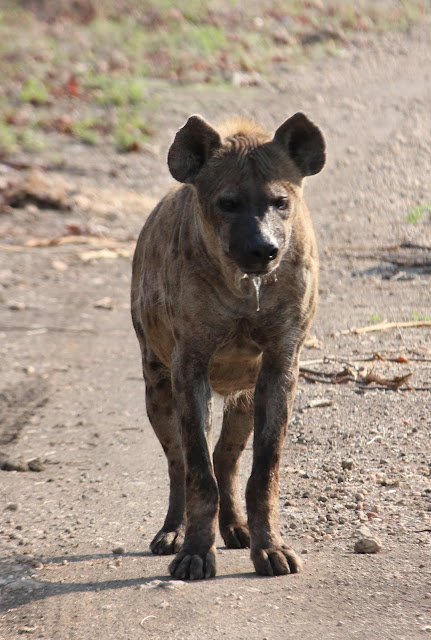
Spotted Hyaena (Crocuta crocuta), Makuleke, Kruger National Park.
The final destination on the tour was to the coastal forests of Kwazulu-Natal to study the habits and habitat of the Forest Cobra (Naja melanoleuca). We camped at Mtunzini and walked for cobras every day. Finding the cobras was easy enough, one day we saw four individuals. Getting a picture was a bit tricky as the snake is very shy. But from what we saw at Mtunzini, the forest cobra likes thick areas in closed canopy forest and also seemed more abundant in areas close to the river there. The way to find them is to walk slowly and silently looking deep into piles of rotting wood and tangles of vegetation. All the ones we saw were on the ground (some moved off into the bushes) and most were basking. At Mtunzini we only saw the Forest Cobras in the day. Looking for cobras we also encountered a few other reptiles in the forest, including the Common Purple-glossed Snake (Amblyodipsas polylepis polylepis), A big Vine Snake (Thelotornis capensis capensis) and the bizarre Giant Legless Skink (Acontias plumbeus).

Common Purple-glossed Snake (Amblyodipsas polylepis polylepis), Mtunzini, KwaZulu Natal.

Giant Legless Skink (Acontias plumbeus), Mtunzini, KwaZulu Natal.


Friday, October 24, 2014

News from the SCBC September 10 - October 1

Dancing Jewel (Platycypha caligata subsp. caligata) a striking predator.
This was the first month of SCBC operations in the area and it was a productive month. The weather was hot and dry, often with a warm desiccating wind, interspersed with cool overcast days. The dry veld exposed the landscape making the beauty of the underlying rocks and contours of the mountain visible.

Colours at sunset
 During the month, in anticipation of the wet season, many plants began to flower. Most notable were the Albizia trees, Cassia trees and Combretum creepers. The Ficus ingens trees also put on an impressive display of red leaves.

Albizia anthelmintica in bloom.
The activities during the month were varied. Biodiversity hikes took up the majority of the time, these were done in the day as well as a few night hikes. There was alien invasive clearing and some horticulture. Another successful activity was snare removal, many of these nasty contraptions were picked up. The idea with the removal of snares is to try and stay ahead of the poachers until they give up putting them up on the property.

A good days hunting - seven snares picked up in thick bush.
 During the month contact was made with Lajuba and Ian Gaigher and we spoke about the Vhembe Biosphere Reserve, conservation in the area now and the future and also different projects and needs in the surrounding area. It is my hope that the SCBC can be an energetic force in the area.

The Dassie, also known as Rock Hyrax (Procavia capensis), a heavily targeted animal for bush meat.
 The month provided some excellent animal sightings, the highlights were a nocturnal observation of a Cape Clawless Otter (Aonyx capensis) and an amphisbaenian (worm lizard).  Looking forward to getting camera traps to begin monitoring the larger mammals in the area.


Soutpansberg Wormlizard (Chirindia langi subsp. occidentalis)
Walking in the drying out river I saw high concentrations of fish. At the moment the fish are being fished out by people coming on to the property. As long as they fish using rods it is fine, but we will not tolerate fish traps and nets because they are indiscriminate.

Tilapia one of the native fish species that occurs on the property
Soutpansberg Flat Lizard (Platysaurus relictus), a Soutpansberg endemic, abundant on the property

BIRD LIST FOR THE MONTH

Natal Spurfowl; Crested Francolin; Crested Guinea fowl;  African Black Duck; Golden-tailed Woodpecker; Cardinal Woodpecker; Bearded Woodpecker; Black-collared Barbet; Yellow-fronted Tinkerbird; Acacia Pied Barbet; Southern Yellow-billed Hornbill; African Grey Hornbill; African Hoopoe; Green Wood-hoopoe; Malachite Kingfisher; Brown-hooded Kingfisher; Giant Kingfisher; Pied Kingfisher; Little Bee-eater; European Bee-eater; Narina Trogon; Red-faced Mousebird; Speckled Mousebird; Red-chested Cuckoo; Klaas's Cuckoo; Burchell's Coucal; Alpine Swift; African Black Swift; Little Swift; Purple-crested Turaco; Barn Owl; Spotted Eagle Owl; Fiery-necked Nightjar; Freckled Nightjar; Speckled Pigeon; Laughing Dove; Red-eyed Dove; Emerald-spotted Wood-dove; Tambourine Dove; Three-banded Plover; African Fish Eagle; Cape Vulture; African Goshawk; Verreaux's Eagle; African Hawk Eagle; Green-backed Heron; Hammerkop; Hadeda Ibis; Black Stork; Black-headed Oriole; African Paradise Flycatcher; Fork-tailed Drongo; Brown-crowned Tchagra; Black-back Puffback; Southern Boubou; Orange-breasted Bushshrike; Gorgeous Bushshrike; Grey-headed Bushshrike; Retz's Helmet-shrike; Cape Batis; Chinspot Batis; Pied Crow; Black Cuckooshrike; Southern Black Tit; Lesser-striped Swallow; Rock Martin; Dark-capped Bulbul; Terrestrial Brownbul; Sombre Greenbul; Yellow-bellied Greenbul; Long-billed Crombec; Cape White-eye; Rattling Cisticola; Tawny-flanked Prinia; Bar-throated Apalis; Yellow-throated Apalis; Grey-backed Cameroptera; Kurrichane Thrush; Ashy Flycatcher; White-throated Robin-chat; Red-capped Robin-chat; White-browed Robin-chat; Bearded Scrub-robin; White-browed Scrub-robin; Familiar Chat; Mocking Cliff-chat; Red-winged Starling; Red-billed Oxpecker; Amethyst Sunbird; Collared Sunbird; White-bellied Sunbird; Red-headed Weaver; Lesser-masked Weaver; Spectacled Weaver; Swee Waxbill; Blue Waxbill; Jameson's Firefinch; Bronze Mannikin; SouthernGrey-headed Sparrow; African Pied Wagtail; Cape Wagtail; Yellow-fronted Canary; Golden-breasted Bunting.

Yellow-bellied Greenbul (Chlorocichla flaviventris subsp. flaviventris), a bird whose call can be likened to sarcastic laughing, always a delight to hear.

MAMMAL LIST FOR THE MONTH

Rock Hyrax; Sharpe's Grysbok; Klipspringer; Kudu; Bush Buck; African Civet; Cape Clawless Otter; Slender Mongoose; Dwarf Mongoose; Water Mongoose; Large-spotted Genet; Leopard; Baboon; Vervet Monkey; Thick-tailed Bushbaby; Tree Squirrel; Porcupine; Jameson's Red Rock Rabbit; Spiny Mouse; Pouched Mouse; Senghi.
(Note on list - list was compiled using visual observations of the animal itself or track and sign. Many animals (rodents and bats) were left out due to unsatisfactory identification.)

Saccostomus campestris, Pouched Mouse.
 REPTILE LIST FOR THE MONTH

Agama atra - Peter's Ground Agama
Chirindia langi occidentalis - Soutpansberg Worm Lizard
Aparallactus capensis - Cape Centipede Eater
Philothamnus semivariegatus - Spotted Bush Snake
Psammophis subtaeniatus - Western Yellow-bellied Sand Snake
Platysaurus relictus - Soutpansberg Flat Lizard
Smaug warreni depressus - Flat Dragon Lizard
Dendroaspis polylepis - Black Mamba
Homopholis wahlbergii - Wahlberg's Velvet Gecko
Afroedura - Flat Gecko (Taxonomy unresolved)
Chondrodactylus turneri - Turner's Gecko
Hemidactylus mabouia - Common Tropical House Gecko
Lygodactylus capensis - Common Dwarf Gecko
Broadleysaurus major - Rough-scaled Plated Lizard
Gerrhosaurus flavigularis - Yellow-throated Plated Lizard
Matobosaurus validus - Giant Plated Lizard
Afroablepharus maculicollis - Spotted-neck Snake-eyed Skink
Scelotes limpopoensis limpopoensis - Limpopo Dwarf Burrowing Skink
Trachylepis varia - Variable Skink
Trachylepis margaritifer - Rainbow Skink
Varanus nilotica - Nile Monitor
Pelusios sinuatus - Serrated Hinged Terrapin
 
Nile Monitor (Varanus niloticus), a massive reptile.
 Keywords for the month: Horticulture, Carnivore, Snare, Baobab, Night Animal.

Introducing the Soutpansberg Centre for Biodiversity and Conservation


Located in the Soutpansberg on the banks of the Sand River, the Soutpansberg Centre for Biodiversity and Conservation has founded in order to progressively change the trajectory of conservation in the Soutpansberg in the context of the greater Vhembe Biosphere Reserve; to catalogue the biodiversity of the Soutpansberg; to reconnect people with the natural world; and to develop proactive environmentalists who will impact their world.
 
View of the Sand River Gorge, home of the Soutpansberg Centre for Biodiversity and Conservation.
The Soutpansberg is a mountain range in the far north of South Africa and is close to the town of Louis Trichard. The mountains are renowned for their beauty and high species endemism. The role of the Soutpansberg Centre for Biodiversity and Conservation is to catalogue this biodiversity, collect data and be a conservational presence in the region. 

The endemic Soutpansberg Flat Lizard (Platysaurus relictus) one of the most colourful animals in the area.
The SCBC is an experimental and independent space for the exchange of ideas, biodiversity research and the practice of conservation. Through approaching conservation from an inclusive rather than exclusive position, our goal is to become a model for eco-tourism and conservation in the area In terms of research, our aim is to collect information on biodiversity in the Soutpansberg and contribute this knowledge to a greater scientific community.

A mountain stream; a hotspot for biodiversity.

Our primary objective in these early stages of development is to begin with research on ecosystems – cataloguing the biodiversity of reptiles, birds, plants, arachnids and insects, and monitoring the larger mammals in the area such as leopards, brown hyeanas, aardvarks and antelope. 

Giant Plated Lizard (Matabosaurus validus), a lizard which can grow to just under a metre in length.
Biodiversity research will be accomplished by actively searching for organisms and setting pit-fall and/or camera traps. All records and documentation will be uploaded to the South African National Biodiversity (SANBI) database, making them accessible to the general public and scientists alike. The SCBC will also engage with other conservationists within the area, sharing research and raising awareness of the project within a broader community.

A community of lichen growing on a rock on a mountain summit.
The Soutpansberg Centre For Biodiversity and Conservation is an independent, not-for-profit research and conservation organization based in the Soutpansberg range to the west of Louis Trichard, Limpopo Province, South Africa and we are currently looking for volunteers to assist us with our project.

Lygus Acraea (Acraea lygus) one of the many species of butterfly found in the Soutpansberg. 
Individuals from all walks of life are invited to participate, specifically those that have a strong link to the natural world and want to be part of a new venture (for more information see soutpansbergcbc.blogspot.com).