keywords

!Garib (2) Acacia karroo (1) afroedura (1) agriculture (1) algae (1) all that crawlith (2) amphibians (3) anthrax (1) aposmatic colouration (2) arachnid (4) arthropod (1) Baobab (3) bat (2) Bat Migration (1) biodiversity (15) bipedalism (1) birds (4) Black Mamba (2) Botswana (1) brumation (1) buffalo (1) Bush Meat (1) bushveld (4) Cambrian (1) Carbon Cycle (1) Central Africa (1) Chameleon (1) chemical erosion (1) coastal forest (1) cocoon (1) coevolution (2) colony (1) conservation (6) consume (1) cosmos (1) cultivation (1) darkling (1) death (3) decomposer (1) Desert (1) Devonian (1) diapsid (2) domestication (1) drought (1) Durban (2) Ecology (9) elapid (2) elephant (1) endemic (2) Energy Cycle (1) eugene marais (2) evolution (2) eye spots (1) fire (2) flash colouration (1) flat dog (1) flower (1) Forest (1) Forest Cobra (1) frog (3) fungus (1) gecko (3) Gondwana (1) Grass (3) herpetology (3) hibernation (1) human culture (8) hyrax (2) identification (3) imago (1) impact crater (1) Inanda (1) Inquiline (1) insect (5) Johannesburg (6) Kalahari (1) Kasanka (1) katydid (3) Klipriviersberg (2) koppies (1) Lajuma (1) larva (1) Leopard (1) Lepidoptera (1) Limpopo (3) Limpopo Valley (1) lowveld (2) Medike Mountain Sanctuary (3) meteorite (1) mimicry (5) mining (2) Miombo (1) mite (1) money (1) moult (1) naja annulifera (1) Namakwa (2) namaqualand (1) natural history (2) nature (7) Neolithic (1) neurotoxic (1) Nietzsche (1) nocturnal (2) Northern Cape (1) nutrient cycle (2) Owl (1) Pafuri (1) Paleoanthropology (1) parasite (2) parasitic (1) pathogenic (1) photosynthesis (1) pioneer (1) Poaching (1) poisoning (1) pollination (1) Predetor and Primate Project (1) raptor (1) reptile (5) reptiles (6) Richtersveld (1) rust (1) savanna (6) scorpion (4) Scorpions (1) selati river (1) skink (1) Snake (7) Snake Snake Snake (2) snouted cobra (1) solifuge (2) South Africa (1) southern africa (1) Soutpansberg (4) Soutpansberg Centre for Biodiversity and Conservation (3) spider (3) spoor (1) spore (1) stone age (1) stridulate (2) Suikerbosrand (1) summer (3) swarm (2) taxonomy (1) Urban Birds Johannesburg (3) Urban ecology (4) Urban Forest (2) Vachellia karroo (1) Vachellia robusta (1) Vachellia xanthophloea (1) Venda (1) venom (1) venus (1) Vhembe Biosphere Reserve (4) waterberg mountains (2) weathering (1) weeds (1) Welgevonden (1) wetland (2) Wheat (1) winter (2) Zambia (1) zoonotic (1)

Blog Archive

Showing posts with label bushveld. Show all posts

Thursday, January 14, 2016

Venda: Biodiversity and Places of Northern Limpopo.


Arnold’s Velvet Gecko (Homopholis arnoldi), Blouberg Nature Reserve

The SCBC has been working on biodiversity data collection in the Soutpansberg area for over a year now. Our activities have been centred on the Medike property on the banks of the Sand River. Due to the vastness of the mountain range and peripheral areas; to broaden the habitats in this biodiversity rich area, the SCBC has now begun to work in different areas. The purpose of this is to increase the SCBC project’s scope and create more accurate data representations of biodiversity assemblage for the region.

Delande’s Beaked Blind Snake (Rhinotyphlops lalandei)
September was set aside as a month for travelling and we began the tour at Blouberg Nature Reserve to the west of the Soutpansberg range. Generally Blouberg is treated as a separate entity, but the mountain is geologically related to the Soutpansberg and under sampled. For the purposes of the SCBCs mandate (to spend time walking searching of biodiversity) Blouberg Nature Reserve was not well suited to the task. Because of the presence of buffalo in the area walking is discouraged. However the little time spent there did turn up some interesting new reptiles for our lists not yet found on the Soutpansberg; Delande’s Beaked Blind Snake (Rhinotyphlops lalandei) and the newly described Arnold’s Velvet Gecko (Homopholis arnoldi). There are a few protected areas around the mountain that are buffalo free and this is an area that has been identified as having a lot of future potential for SCBC work.

Sunduvall's Writhing Skink (Mochlus sundevalli), Mashovella, Soutpansberg.
After Blouberg it was our intention to explore the Northern slopes of the Western Soutpansberg, unfortunately the few sites that offer accommodation were fully booked. We spent a night at Mashovella, which is situated in a beautiful valley. Unfortunately Mashovella is not conducive to research, the accommodation is expensive and there are many rules governing activity on the property. So we moved on to a small farm called Zvakanaka. The property is small but gives access to quite a large chunk of the moister and higher Southern slopes of the Soutpansberg. The property is wedged between agricultural land and is very conducive to research. Unfortunately the weather was cold and we could not work, so decided to head east for warmer and dryer weather.

Mopane Veld, Nwanedi Nature Reserve, Limpopo.

Leopard Tortoise (Stigmochelys pardalis), Nwanedi Nature Reserve, Limpopo.

One of the habitats that we needed to sample was the Mopane Veld which grows on the northern edges of the Soutpansberg.  We decided to spend a few days at Nwanedi Nature Reserve. Nwanedi is a large reserve, comprised of riverine vegetation patches, Mopane veld and arid mountain savannah. The region is extremely hot and dry. Nwanedi proved to be very productive and conducive to research. Permission to walk anywhere was easily granted and there is also a good road network. We spent six nights at Nwanedi and made a list of 16 reptiles (four of which were new for the SCBC lists) and we also found six species of scorpion. The SCBC will certainly do more forays to Nwanedi in the coming months.

Pachydactylus punctatus, Nwanedi Nature Reserve.

Limpopo girdled lizard (Cordylus jonesii), Nwanedi Nature Reserve.

Holub's Sandveld Lizard (Nucras holubi), Nwanedi


Being in Venda we decided to spend a few nights in a rural site near the village of Segole at the Big Tree Lodge. The lodge is next to a property where there is a massive Baobab tree. The is claimed to be the biggest in the world and is estimated to be over 3000 years old. The tree is one of the most remarkable organisms that I have ever seen. Segole was good for reptiles – in the few days there we created a list of 15 species, including three new species for our lists. We used the big tree lodge as our base and I can recommend the place to anyone travelling in the area.

The Big Tree, Adansonia digitata at Segole.
East African Shovel-Snout (Prosymna stuhlmanni), Segole.
Common Barking Gecko (Ptenopus garrulus garrulus), Segole.
Parabuthus mossambicensis, Segole.
Still very much in the Venda area we travelled to the forested slopes of the far eastern Soutpansberg and stayed at Golwe-Vhurivhuri campsite. The community runs the campsite and the facilities are excellent. They have ample space for camping and two safari tents for those who want a bit of luxury. The campsite is situated on a river in a forest and is an excellent area for birding, otherwise difficult to see species like African Broadbill, Eastern Nicator, Narina Trogon and even Pink-throated Twinspot are very easily observed in and around the campsite. Our time at Golwe-Vhurivhuri turned up two new lizards for our lists as well as a new scorpion.

Zygaspis quadrifrons, Golwe-Vhurvhuri, Eastern Soutpansberg.

Spotted Sandveld Lizard (Nucras intertexta), Golwe-Vhurvhuri, Eastern Soutpansberg.
Forest at Golwe-Vhurvhuri, Eastern Soutpansberg.
The forest that Golwe-Vhurivhuri connects to is full of secrets and recently turned up the second record of a Forest Cobra, Naja melanoleuca. Looking at the habitat in the forest as Golwe-Vhurivhuri and comparing it to suitable habitat in the KZN coastal forests, future work in the area is bound to reveal the presence of this shy snake. During 2016 the SCBC will make regular forays into the area.

Still following our west east trajectory we decided to end the Limpopo part of the tour at Pafuri on the eastern limits of our catchment area. We stayed at Pafuri River Camp on the banks of the Mutale River just south of the Limpopo. The property boasts some nice riverine bush with Mopane veld scattered with Baobabs. The Mopane veld in the area was crawling with Pachydactylus punctisima and in some patches the density of this species was remarkable. For scorpions the area is very good and a reliable place to find Uroplectes chubbi, Lychas burdoi and many Hottentota trilineata.
Nile Crocodile (Crocodylus niloticus), Pafuri, Kruger National Park.

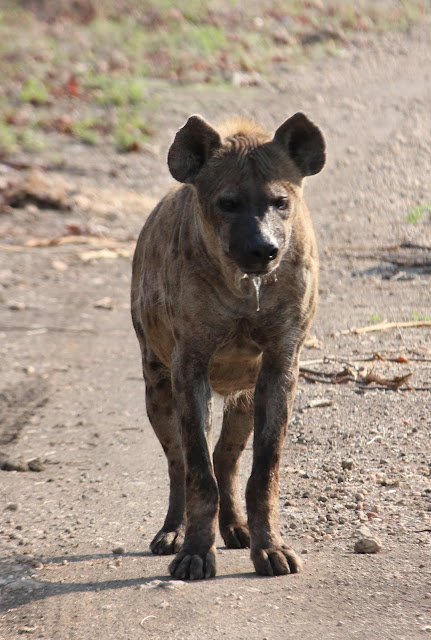
Spotted Hyaena (Crocuta crocuta), Makuleke, Kruger National Park.
The final destination on the tour was to the coastal forests of Kwazulu-Natal to study the habits and habitat of the Forest Cobra (Naja melanoleuca). We camped at Mtunzini and walked for cobras every day. Finding the cobras was easy enough, one day we saw four individuals. Getting a picture was a bit tricky as the snake is very shy. But from what we saw at Mtunzini, the forest cobra likes thick areas in closed canopy forest and also seemed more abundant in areas close to the river there. The way to find them is to walk slowly and silently looking deep into piles of rotting wood and tangles of vegetation. All the ones we saw were on the ground (some moved off into the bushes) and most were basking. At Mtunzini we only saw the Forest Cobras in the day. Looking for cobras we also encountered a few other reptiles in the forest, including the Common Purple-glossed Snake (Amblyodipsas polylepis polylepis), A big Vine Snake (Thelotornis capensis capensis) and the bizarre Giant Legless Skink (Acontias plumbeus).

Common Purple-glossed Snake (Amblyodipsas polylepis polylepis), Mtunzini, KwaZulu Natal.

Giant Legless Skink (Acontias plumbeus), Mtunzini, KwaZulu Natal.


Saturday, August 23, 2014

Winter in Welgevonden Private Game Reserve - Limpopo


Typical woodland in Welgevonden. The main trees are Burkea africana and Terminalia sericea.
I spent winter of this year in the Welgevonden Private Game Reserve, just outside of Vaalwater in the Limpopo Provence of South Africa. The job I was doing was working with researchers in the field collecting data for their university research. The data we were busy collecting was primarily concerned with elephant impact on the environment and also how that environmental impact effected birds. As far as jobs go this is one of the best jobs one can do, you are working with people who are switched on and enthusiastic about nature. There was a good energy and it was an excellent place to spend winter.
This carnivorous plant was a good find. It is amazing to see these plants, they are very strange. This is Shepard's Crook Sundew (Drosera aliciae).
Winged Wooden Pear (Schrebera alata). One of the many interesting plants found during habitat assesments.
Welgevonden is situated in the Waterberg Mountains and is an interesting mix of high plateau vegetation, grassland and woodland. The main trees dominating the landscape are Termenalia species, Faurea saligna and Burkea africana. All of these trees are adapted to survive the regular fires that burn through the grasslands every few years.
Faurea saligna, the Transvaal Beech. These mighty trees grow tall and superficially resemble Eucalyptus trees. 
Marico Sunbird flits around in a Cape Honey Suckle. The call of this little bird was often heard in the research camp.
The veld type in the area is considered sourveld. Sourveld is apposed to sweetveld and refers to the palatability of the veld, which is determined by the soil conditions which are broadly influenced by climate and geology. Sourveld generally occurs in regions where there is a lot of rainfall and very cold winters. The high rainfall tends to remove nutrients from the soil decreasing the pH value in the soil. Grasses growing in this veld are poor in nutrients and because of this are considered unpalatable, in addition to this the grasses, in an effort to prevent the loss of nutrients, withdraw nutrients from the leaves at the onset of the dry season making the grasses even more unpalatable and lacking in nutritional value.[i] During the dry season, Welgevonden management has to put out lick blocks in order to try and help animals get their vitamins and minerals.

Wildebeest that died of mange related complications. Wildebeest seemed to particularly suffer from mange on the reserve and I am sure this can be linked to the poor grazing of the sourveld.
From a biodiversity perspective the area is relatively rich considering its altitude and the veld type. The birding in the area was good and during the six weeks in the reserve, the group of researchers and I managed to compile a bird list that reached 126, which is not bad for winter. There were some notable sightings. Highlights for me include Cape Vultures, Black-chested Snake Eagles (we saw these birds a lot), Denham’s Bustard, Coqui and Shelly’s Francolin (these were also very vocal) and Lanner Falcons. [ii]

Ground-scraper Thrush. Very active little birds.
The Little Bee-eater. These are incredibly photogenic birds. They hawk insects from a perch and can often be seen in pairs.
An uncommon bird, Denham's Bustard. These birds are listed as near threatened due to habitat loss.
The Coqui Francolin. A beautiful little game bird.
Shelly's Francolin, another special little game bird that was heard and seen often at Welgevonden.
The Ant-eating Chat. This one has some mud on its feet and bill adding an interesting colouration to an otherwise drab bird.
There were many Familiar Chats on Welgevonden. Very interesting birds to watch as they are usually very active.
What tourists want to see. The lion, one of the big five.
Welgevonden Private Game Reserve exists in order to attract people to come on safari and enjoy seeing big game animals. Today seeing the ‘big five’ is one of the must do things in Africa and many of the private game reserves and their lodges cater to this need. Big five equals big money and that is the long and short of it. In a way it is unfortunate because lodge management really push this big five agenda on their nature guides and the entire experience becomes an artificial one. Guides are pressured into finding their guests the big five (this pressure does not necessarily come from the guests, but rather the management) and tend to neglect the smaller things that really make a bush experience magical. Radios tuned in, guides chase sightings often missing out on other sighting because of this tunnel vision. On one occasion in Welgevonden we had an incredible lion sighting at one of the central plains. Three lions stalked a baby rhino and then some warthogs. So many safari trucks must have driven past the plains and no one saw the lions until they saw us watching them because they were chasing sighting on the radio.

An interesting interaction. We watched these lions stalk a baby rhinoceros, the mother of the calf quickly showed them that she was not going to let it happen that easily.
Cheetah's are beautiful cats. Their sleek coats and slender build really are captivating.
Another aspect of the Game Reserve that struck me as artificial is the fertilization of the land to support more grazers and therefore more predators. There is also a constant restocking of game animals such as Wildebeest and Zebras. That said, Welgevonden Game Reserve is a good place for Game viewing. During the six weeks I was there, we had some very good game sightings. White Rhinoceros were especially easy to see and we had some incredible encounters with elephants. Welgevonden is also the first place I have seen Bushpigs from a vehicle in the day.

A view from the research camp. Typically on any day there would be plentiful game outside the research camp. In this picture there are Guinea Fowl in the foreground, Impala behind them and in the distance some White Rhinoceros.
Paper Wasps on their nest. These small colonies are dominated by a single female, her daughters help her gather food and raise a new generation of wasps.
A large Huntsman Spider (Sparassidae) found on a rocky outcrop.
These Darklings (Tenebrionidae) were sheltering under some bark that was being warmed by the sun.
One day some of the researchers caught this fish in a stream, I am not sure of the species, but I think the genus is likely to be Barbus.
In respect of smaller animals, Welgevonden Private Game Reserve has a lot to offer. There are many Klipspringers on the rocks, Rock Hyraxes and it was common to Black-backed Jackals. Banded Mongooses, Dwarf Mongooses and Slender Mongooses were regularly seen while out and about in the reserve. We also saw a surprising amount of reptiles. Surprising because it was winter and the work we were doing was not really conducive to reptile hunting.[iii]

A little female Klipspringer, these small antelope are at home in rocky areas, especially hill slopes that are inaccessible to other antelope.
Black-backed Jackals are commonly seen during the day in Welgevonden. Their nightly chorus of melancholy wailing is one of the most distinctly African bush sounds.
Foxy Charaxes (Charaxes jasius subsp. saturnus).
The Nile Crocodile affectionately know as the Flat Dog in Southern Africa.
Spotted Sand Lizard (Pedioplanis lineoocellata subsp. lineoocellata). The lizards are fast.
Trachlepis varia, the Variable Skink. This species is my favourite skink. They have a very large distribution and quickly become used to human presence.
A juvenile Transvaal Gecko (Pachydactylus affinis).
The Herald Snake, Crotaphopeltis hotamboeia. An amphibian specialist.
Bibron's Blind Snake (Afrotyphlops bibronii). A snake well adapted to a life underground. Scales have grown over the eyes which can be seen as dark points on the side of the head. The snake preys on termites and their larvae.
The Cape Centipede-eater (Aparallactus capensis) preys on centipedes. Not many snakes are invertebrate specialists, making it a good niche to exploit. 
Short-snouted Grass Snake (Psammophis brevirostris). A fast diurnal snake.
This Speckled Rock Skink (Trachylepis punctatissima) was trying to overcome a Carpenter Bee (Xylocopa). I am not sure what the result of this struggle was, but the lizard was committed.
 Overall it was a beautiful winter. The icy mornings with accompanying frost tangibly demonstrated the power of winter and its brutal nature: killing the weak and weakening the strong. As the morning progresses and the sun ascends, the warmth of that star becomes very noticeable. The fawn colour of the landscape and the atmosphere of starkness that is created by the leafless trees was arresting. I distinctly remember standing in the open one morning watching the grass moving with the wind. The motion struck me as fluid and for a moment I could see he air itself. These incommunicable experiences where one feels a powerful connection to the earth and nature are what motivate me to continue a lifestyle that is tied as closely to nature as possible.
View of one of the central plains early one morning.
  

[i] F. van Oudtshoorn. 2012. Guide to Grasses of southern Africa. Briza Publications: Pretoria. pg 28.

[ii] List of Birds seen at Welgevonden:
Shelly’s Francolin, Coqui Francolin, Natal Spurfowl, Helmeted Guineafowl, Egyptian Goose, African Black Duck, Greater Honeyguide, Lesser Honeyguide, Bearded Woodpecker, Cardinal Woodpecker, Black-collared Barbet, Crested Barbet, Southern Yellow-billed Hornbill, African Grey Hornbill, African Hoopoe, Green Wood-hoopoe, Lilac-breasted Roller, Malachite Kingfisher, Brown-hooded Kingfisher, Giant Kingfisher, Pied Kingfisher, Little Bee-eater, White-fronted Bee-eater, Speckled Mousebird, Klaas’s Cuckoo, Burchell’s Coucal, Grey Go-away Bird, Barn Owl, Grass Owl, Pearl-spotted Owlett, Spotted Eagle Owl, Fiery-necked Nightjar, Freckled Nightjar, Speckled Pigeon, African Green Pigeon, Laughing Dove, Cape Turtle-Dove, Red-eyed Dove, Emerald-spotted Wood-dove, Denham’s Bustard, African Jacana, Blacksmith Lapwing, African Wattled Lapwing, Crowned Lapwing, Black-shouldered Kite, African Fish-Eagle, Cape Vulture, Brown Snake-Eagle, Black-chested Snake-Eagle, Black Sparrowhawk, Gabar Goshawk, Jackal Buzzard, African Harrier-Hawk, African Hawk-Eagle, Martial Eagle, Rock Kestrel, Lanner Falcon, African Darter, White-breasted Cormorant,  Little Grebe, Grey Heron, Hammerkop, Hadeda Ibis, Black Stork, Black-headed Oriole, Fork-tailed Drongo, Brubru, Black-backed Puffback, Black-crowned Tchagra, Southern Boubou, Orange-breasted Bush-Shrike, Grey-headed Bush-Shrike, White-crested Helmet-Shrike, Chinspot Batis, Pied Crow, Common Fiscal, Southern Black Tit, Rock Martin, Brown-throated Martin, Pearl-breasted Swallow, Lesser Striped Swallow, Dark-capped Bulbul, Cape Grassbird, Long-billed Crombec, Arrow-marked Babbler, Cape White-eye, Croaking Cisticola, Rattling Cisticola, Neddicky, Tawny-flanked Prinia, Bar-throated Apalis, Grey-backed Camaroptera, Rufous-naped Lark, Kurrichane Thrush, Groundscraper Thrush, Southern Black Flycatcher, White-throated Robin-Chat, White-browed Scrub-Robin, African Stonechat, Familiar Chat, Capped Wheatear, Ant-eating Chat, Red-winged Starling, Cape Glossy Starling, Red-billed Oxpecker, Amethyst Sunbird, White-bellied Sunbird, Marico Sunbird, Red-headed Weaver, Southern Masked Weaver, Red-billed Quelea, Long-tailed Widowbird, Red-collared Widowbird, Common Waxbill, Blue Waxbill, African Firefinch, Jameson’s Firefinch, Southern Grey-headed Sparrow, Cape Wagtail, Cape Longclaw, African Pipit, Yellow-fronted Canary, Streaky-headed Seedeater, Cinnamon-breasted Bunting, Golden-breasted Bunting


[iii] List of Reptiles: 
Bibron’s Blind Snake, Cape Centipede-eater, Short-snouted Grass Snake, Western Stripe-bellied Sand Snake, Herald Snake, Distant’s Ground Agama, Southern Tree Agama, Variable Skink, Rainbow Skink, Speckled Rock Skink, Waterberg Flat Lizard, Giant Plated Lizard, Transvaal Girdled Lizard, Spotted Sand Lizard, Common Rough Scaled Lizard, Tropical House Gecko, Transvaal Gecko, Common Dwarf Gecko, Nile Crocodile