keywords

!Garib (2) Acacia karroo (1) afroedura (1) agriculture (1) algae (1) all that crawlith (2) amphibians (3) anthrax (1) aposmatic colouration (2) arachnid (4) arthropod (1) Baobab (3) bat (2) Bat Migration (1) biodiversity (15) bipedalism (1) birds (4) Black Mamba (2) Botswana (1) brumation (1) buffalo (1) Bush Meat (1) bushveld (4) Cambrian (1) Carbon Cycle (1) Central Africa (1) Chameleon (1) chemical erosion (1) coastal forest (1) cocoon (1) coevolution (2) colony (1) conservation (6) consume (1) cosmos (1) cultivation (1) darkling (1) death (3) decomposer (1) Desert (1) Devonian (1) diapsid (2) domestication (1) drought (1) Durban (2) Ecology (9) elapid (2) elephant (1) endemic (2) Energy Cycle (1) eugene marais (2) evolution (2) eye spots (1) fire (2) flash colouration (1) flat dog (1) flower (1) Forest (1) Forest Cobra (1) frog (3) fungus (1) gecko (3) Gondwana (1) Grass (3) herpetology (3) hibernation (1) human culture (8) hyrax (2) identification (3) imago (1) impact crater (1) Inanda (1) Inquiline (1) insect (5) Johannesburg (6) Kalahari (1) Kasanka (1) katydid (3) Klipriviersberg (2) koppies (1) Lajuma (1) larva (1) Leopard (1) Lepidoptera (1) Limpopo (3) Limpopo Valley (1) lowveld (2) Medike Mountain Sanctuary (3) meteorite (1) mimicry (5) mining (2) Miombo (1) mite (1) money (1) moult (1) naja annulifera (1) Namakwa (2) namaqualand (1) natural history (2) nature (7) Neolithic (1) neurotoxic (1) Nietzsche (1) nocturnal (2) Northern Cape (1) nutrient cycle (2) Owl (1) Pafuri (1) Paleoanthropology (1) parasite (2) parasitic (1) pathogenic (1) photosynthesis (1) pioneer (1) Poaching (1) poisoning (1) pollination (1) Predetor and Primate Project (1) raptor (1) reptile (5) reptiles (6) Richtersveld (1) rust (1) savanna (6) scorpion (4) Scorpions (1) selati river (1) skink (1) Snake (7) Snake Snake Snake (2) snouted cobra (1) solifuge (2) South Africa (1) southern africa (1) Soutpansberg (4) Soutpansberg Centre for Biodiversity and Conservation (3) spider (3) spoor (1) spore (1) stone age (1) stridulate (2) Suikerbosrand (1) summer (3) swarm (2) taxonomy (1) Urban Birds Johannesburg (3) Urban ecology (4) Urban Forest (2) Vachellia karroo (1) Vachellia robusta (1) Vachellia xanthophloea (1) Venda (1) venom (1) venus (1) Vhembe Biosphere Reserve (4) waterberg mountains (2) weathering (1) weeds (1) Welgevonden (1) wetland (2) Wheat (1) winter (2) Zambia (1) zoonotic (1)

Blog Archive

Showing posts with label all that crawlith. Show all posts

Thursday, January 14, 2016

Venda: Biodiversity and Places of Northern Limpopo.


Arnold’s Velvet Gecko (Homopholis arnoldi), Blouberg Nature Reserve

The SCBC has been working on biodiversity data collection in the Soutpansberg area for over a year now. Our activities have been centred on the Medike property on the banks of the Sand River. Due to the vastness of the mountain range and peripheral areas; to broaden the habitats in this biodiversity rich area, the SCBC has now begun to work in different areas. The purpose of this is to increase the SCBC project’s scope and create more accurate data representations of biodiversity assemblage for the region.

Delande’s Beaked Blind Snake (Rhinotyphlops lalandei)
September was set aside as a month for travelling and we began the tour at Blouberg Nature Reserve to the west of the Soutpansberg range. Generally Blouberg is treated as a separate entity, but the mountain is geologically related to the Soutpansberg and under sampled. For the purposes of the SCBCs mandate (to spend time walking searching of biodiversity) Blouberg Nature Reserve was not well suited to the task. Because of the presence of buffalo in the area walking is discouraged. However the little time spent there did turn up some interesting new reptiles for our lists not yet found on the Soutpansberg; Delande’s Beaked Blind Snake (Rhinotyphlops lalandei) and the newly described Arnold’s Velvet Gecko (Homopholis arnoldi). There are a few protected areas around the mountain that are buffalo free and this is an area that has been identified as having a lot of future potential for SCBC work.

Sunduvall's Writhing Skink (Mochlus sundevalli), Mashovella, Soutpansberg.
After Blouberg it was our intention to explore the Northern slopes of the Western Soutpansberg, unfortunately the few sites that offer accommodation were fully booked. We spent a night at Mashovella, which is situated in a beautiful valley. Unfortunately Mashovella is not conducive to research, the accommodation is expensive and there are many rules governing activity on the property. So we moved on to a small farm called Zvakanaka. The property is small but gives access to quite a large chunk of the moister and higher Southern slopes of the Soutpansberg. The property is wedged between agricultural land and is very conducive to research. Unfortunately the weather was cold and we could not work, so decided to head east for warmer and dryer weather.

Mopane Veld, Nwanedi Nature Reserve, Limpopo.

Leopard Tortoise (Stigmochelys pardalis), Nwanedi Nature Reserve, Limpopo.

One of the habitats that we needed to sample was the Mopane Veld which grows on the northern edges of the Soutpansberg.  We decided to spend a few days at Nwanedi Nature Reserve. Nwanedi is a large reserve, comprised of riverine vegetation patches, Mopane veld and arid mountain savannah. The region is extremely hot and dry. Nwanedi proved to be very productive and conducive to research. Permission to walk anywhere was easily granted and there is also a good road network. We spent six nights at Nwanedi and made a list of 16 reptiles (four of which were new for the SCBC lists) and we also found six species of scorpion. The SCBC will certainly do more forays to Nwanedi in the coming months.

Pachydactylus punctatus, Nwanedi Nature Reserve.

Limpopo girdled lizard (Cordylus jonesii), Nwanedi Nature Reserve.

Holub's Sandveld Lizard (Nucras holubi), Nwanedi


Being in Venda we decided to spend a few nights in a rural site near the village of Segole at the Big Tree Lodge. The lodge is next to a property where there is a massive Baobab tree. The is claimed to be the biggest in the world and is estimated to be over 3000 years old. The tree is one of the most remarkable organisms that I have ever seen. Segole was good for reptiles – in the few days there we created a list of 15 species, including three new species for our lists. We used the big tree lodge as our base and I can recommend the place to anyone travelling in the area.

The Big Tree, Adansonia digitata at Segole.
East African Shovel-Snout (Prosymna stuhlmanni), Segole.
Common Barking Gecko (Ptenopus garrulus garrulus), Segole.
Parabuthus mossambicensis, Segole.
Still very much in the Venda area we travelled to the forested slopes of the far eastern Soutpansberg and stayed at Golwe-Vhurivhuri campsite. The community runs the campsite and the facilities are excellent. They have ample space for camping and two safari tents for those who want a bit of luxury. The campsite is situated on a river in a forest and is an excellent area for birding, otherwise difficult to see species like African Broadbill, Eastern Nicator, Narina Trogon and even Pink-throated Twinspot are very easily observed in and around the campsite. Our time at Golwe-Vhurivhuri turned up two new lizards for our lists as well as a new scorpion.

Zygaspis quadrifrons, Golwe-Vhurvhuri, Eastern Soutpansberg.

Spotted Sandveld Lizard (Nucras intertexta), Golwe-Vhurvhuri, Eastern Soutpansberg.
Forest at Golwe-Vhurvhuri, Eastern Soutpansberg.
The forest that Golwe-Vhurivhuri connects to is full of secrets and recently turned up the second record of a Forest Cobra, Naja melanoleuca. Looking at the habitat in the forest as Golwe-Vhurivhuri and comparing it to suitable habitat in the KZN coastal forests, future work in the area is bound to reveal the presence of this shy snake. During 2016 the SCBC will make regular forays into the area.

Still following our west east trajectory we decided to end the Limpopo part of the tour at Pafuri on the eastern limits of our catchment area. We stayed at Pafuri River Camp on the banks of the Mutale River just south of the Limpopo. The property boasts some nice riverine bush with Mopane veld scattered with Baobabs. The Mopane veld in the area was crawling with Pachydactylus punctisima and in some patches the density of this species was remarkable. For scorpions the area is very good and a reliable place to find Uroplectes chubbi, Lychas burdoi and many Hottentota trilineata.
Nile Crocodile (Crocodylus niloticus), Pafuri, Kruger National Park.

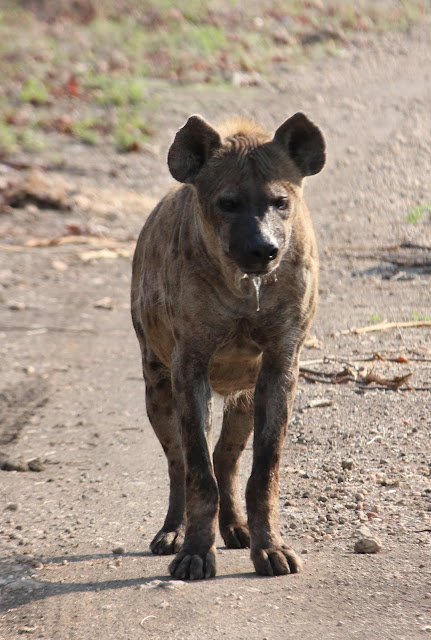
Spotted Hyaena (Crocuta crocuta), Makuleke, Kruger National Park.
The final destination on the tour was to the coastal forests of Kwazulu-Natal to study the habits and habitat of the Forest Cobra (Naja melanoleuca). We camped at Mtunzini and walked for cobras every day. Finding the cobras was easy enough, one day we saw four individuals. Getting a picture was a bit tricky as the snake is very shy. But from what we saw at Mtunzini, the forest cobra likes thick areas in closed canopy forest and also seemed more abundant in areas close to the river there. The way to find them is to walk slowly and silently looking deep into piles of rotting wood and tangles of vegetation. All the ones we saw were on the ground (some moved off into the bushes) and most were basking. At Mtunzini we only saw the Forest Cobras in the day. Looking for cobras we also encountered a few other reptiles in the forest, including the Common Purple-glossed Snake (Amblyodipsas polylepis polylepis), A big Vine Snake (Thelotornis capensis capensis) and the bizarre Giant Legless Skink (Acontias plumbeus).

Common Purple-glossed Snake (Amblyodipsas polylepis polylepis), Mtunzini, KwaZulu Natal.

Giant Legless Skink (Acontias plumbeus), Mtunzini, KwaZulu Natal.


Tuesday, February 25, 2014

Waterberg, Masebe Nature Reserve


For the summer of 2013/2014 I spent two months in the Waterberg Biosphere Reserve at a small Nature Reserve called Masebe. Masebe Nature Reserve is characterized by its sandstone rock formations that create a dramatically imposing and scenic landscape. Buttes and mesas jut out of the plains and between these there are plains and valleys, creating a varied mix of habitats rich in biodiversity. The Masebe Nature Reserve is not very big, perhaps 4 500 hectares in total and that is split into two by a road, but it is preserving a very unique piece of the Waterberg.
Life is everywhere, one just has to look a little closer at ones surroundings and there you will find creatures moving about and living out their lives. Here two mantids are mating. To the human observer this is just another banal phenomenon in the world. To these mantids this is the pinnacle of their lives.
The general biodiversity of the area is incredibly high and I was pleasantly surprised to find so many different types of insects, scorpions and reptiles. I will show case the diversity I was finding out there here with some information here and there on the organisms.

LANDSCAPE AND ENVIRONMENT
Lightning striking one of the Mesas during a typical thunder storm.
Masebe is a very scenic nature reserve. This picture shows the buttes and mesas nicely.
In between all mesas and buttes are the plains, they are typical Savanna woodlands with an understory of grass. The grass in this image is Perotis patens.
The rocky areas exhibit beautiful specimens of Euphorbia cooperi, also known as the Deadliest Euphorbia. Other rocky outcrops were bare.
Bauhinia petersiana subsp. macrantha. The delicate white flowers of these plants was a striking contrast to the sea of green that they grow in. The flower is nearly as thin as tissue.

INSECTS

Bromophila caffra, these large flies are found in large numbers during the hottest and wettest months. They are very slow moving and fly very lazily. The colouration on them resembles some of the larger spider hunting wasps, except in the wasps there is usually an abdomen that has a bit of red on it.   
The diversity of insect in Masebe Nature Reserve is very rich. Particularly the Coleoptera and specifically the Tenebrionidae. I saw many amazing animals and learned a lot from what I saw. Many of the insects I saw were animals I have never seen before and I witnessed some very rich interactions. Below are some of my highlights.
This small Mantid Nymph resembled an ant.
Empusidae, the beautiful Cone-head Mantid.

CMR beetle (Hycleus oculatus). These beetles feed on flowers and are also very toxic as their colour suggests.

Fruit chafer (Amazula suavis). A very striking beetle.
Superficially resembling a Rhino Beetle, this Dung beetle (Copris) still looks impressive with that horn.
One of the most striking beetles I have seen Taurhina splendens.
This hister beetle of the Histeridae family preys on the larva soft larva of flies. This particular individual was found high up on a cliff very close to a hyrax midden.
A  Cypholoba alveolata ground beetle. Many of these could be seen hunting at night.
Cypholoba alveolata. While photographing these beetles the female was trying to kill a chafer.
The uncommon Craspedophorus, another ground beetle. The warning colours on this individual are a bluff.
Termophilum omoplatum, these carnivorous ground beetles mimic the "oog pister" or Anthia beetle.
Ground beetle (Termophilum burchelli subsp. burchelli). The aposematic colouration on this individual is a false warning. This beetle is another Anthia mimic.
This Ground Beetle (Carabidae) Larvae is a fierce predator. Not sure which species.
Anomalipus a darkling beetle that was very common around Masebe Nature Reserve.
Another darkling beetle, this one is another Anomalipus.
Another Darkling (Tenebrionidae), perhaps a Psammodes.
Another Darkling (Tenebrionidae), this is known as the Caramel-plucker Tokkie.
More Darkling Beetles (Tenebrionidae). Not sure of the genus, I have been told it is either Psammodes or Phanerotomea. But the two are very to tell apart.
Psammodes, another darkling that was common around the reserve.
This beautiful beetle is called the Pleasing Fungus Beetle (Erotylidae). The markings on this individual resemble the batman logo.
Lycus, Net-winged Beetles are very common in the grassy area. These four seemed to be three males attempting to mate a female.
This is the egg case of a tortoise beetle, most probably  Conchyloctenia tripuncticollis.
Conchyloctenia tripuncticollis. A tortoise beetle.
Termite-eater Click Beetle (Tetralobus flabellicornis). It is said the the larvae of this beetle is covered in long hairs, lives in wood and feeds on termites. Very interesting beetles.
Tetralobus another Click Beetle. Not sure which species this is.


A big Longhorn Beetle (Macrotoma?). One of the many strange beetles I came across this summer.
This nice looking longhorn (Cerambycidae) was about 3cm in length.
This large sugar ant (3cm) was moving around at night on sandstone rock face. I could see only the one. I think it is from the genus Camponotus.
A beautiful lacewing (Palpares).
Green milkweed locust (Phymateus viridipes subsp. viridipes). These locusts feed on milkweed (Asclepias) and become very toxic.
Cymatomera denticollis. These dull looking katydids flare up their wings when disturbed revealing strong red, yellow and black colouration. This is known as flash colouration and has an effect of startling the threat.
Acanthoplus armativentris, the Armoured Ground Cricket. At certain times of year these crickets are very abundant and come out in thousands. This summer I never saw too many.
Sia cricket. These large crickets "hiss" when molested by rubbing their mouth parts together.
Termophilum omoplatum feeding on a Sia cricket. 
A Raaskriek (Brachytrupes). These large burrowing crickets are incredibly loud, the name Raaskriek is Afrikaans and can roughly be translated to Noise Cricket.
Zabalius aridus, this is a very large leaf mimicking Katydid.
Nymphs of Phymateus another Milkweed Locust. The aposematic colouration is a clear warning of its toxic chemical composition.
Cephonodes hylas subsp. virescens.
Acontia niphogona, a moth that mimics bird droppings.
Amerila vitrea subsp. vitrea, a Frother Moth.
Every year there is a period of time when these butterflies are everywhere, gently flying from east to west in search of plants to lay their eggs on. This is Brown-Veined White (Belenois aurota subsp. aurota.
A butterfly of the Sphingidae family.
Small-striped Swordtail (Graphium policenes subsp. policenes).
Graphium morania
This small caterpillar was found in grassland. I think it may be a species of Acraea (Nymphalidae), but I am not certain.
Rhanidophora. As this caterpillar moves it moves the club like appendages on its body. To me they seem to simulate the restless movement of a wasp.
Psychidae, the bag worm caterpillar.


ARACHNIDS
Of the arachnids, the most species rich group (next to spiders) was the scorpions. There were very many species in the area. Usually one may find only a few species in any given area, but at Masebe Nature Reserve there is a high scorpion biodiversity. On a single night it was not uncommon to find five different species. The most common being Parabuthus transvaalicus and Opisthacanthus asper, followed by Uroplectes carinatus, then Parabuthus mossambicensis and finally Opistophthalmus glabrifrons.


Opistophthalmus glabrifrons, these large scorpions burrow prey on millipedes. They use their powerful pincers to crush their prey. The sting of this species is considered harmless to humans, but is very painful
Parabuthus mossambicensis, these scorpions were common in the area. This one was killing a mantid.
Parabuthus transvaalicus is a very common and active scorpion in Masebe and the surrounding area. These scorpions are big and one of the few whose sting is considered medically important.


Opisthacanthus asper, a tree dwelling species. This scorpion was crossing open ground at night, perhaps in search of a female or a new tree. These scorpions are very docile.


Uroplectes carinatus, a very common scorpion of the Masebe area.
Not sure what species of scorpion this is, but I think it may be Pseudolychas.
The peaceful and docile Hadogenes troglodytes. These scorpions get very long and are considered the longest in the world (21cm). They are rock specialists.
Another scorpion found in the area. I only found one of this particular individual and it is an unknown Uroplectes species.
I watched this solifuge kill another. It kept attacking the one in front from a position underneath the abdomen close to the head area. Eventually it killed the other and ran off with it. Quite a sighting.
The Rear horned baboon spider (Ceratogyrus darlingi). These spiders live in large webbed burrows and sometimes one can trick them into coming out.
This small mantid was being eaten by a crab spider (Thomisops). It is fascinating the the dramas of life and death play out on everywhere on such a drastic range of scales.
Amblyomma, a very striking tick. It is amazing to watch these arachnids walk around and hunt.
Trombidiidae, the velvet mite. These mites are predators on the eggs of insects. They come out in hundreds after the summer rains. In Zambia they are colloquially known as "Father Christmas".

OTHER ARTHROPODS
Mating millipedes (Diplopoda).
 Sphaerotherium or Pill Millipedes are able to roll themselves up into little balls.

A very striking millipede (Diplopoda). The aposematic colouration is warning that it is very poisonous.
A very large centipede (Scolopendromorpha).
The head of the same centipede. The venom claws are prominent.

AMPHIBIANS
Found some interesting amphibians. The most common and most diverse group was the toads. Besides the toads there were many Kassinas, Sand Frogs, Banded Rubber Frogs and Common Plattanas. Across the road from our accommodation there was a wetland and the chorus during December was incredibly loud.
 
Kassina senegalensis, the Bubbling Kassina, one of my favourite frogs. The call sounds exactly like bursting bubbles and to hear them calling en masse is a treat.
Bushveld Rain Frog (Breviceps adspersus subsp. adspersus). During the height of Summer (November and December) these frogs were very common. They live underground and it is fascinating to watch them bury themselves. Digging backwards and wriggling until they have completely disappeared.
Amietophrynus garmani, the Eastern Olive Toad. This particular individual was massive (at least 11cm long) and in very good condition.
The Southern Foam Nest Frog, Chiromantis xerampelina. This individual was found high up on the cliff base of a butte. Very far from water. These frogs often sit in exposed positions, their feet and hands tucked under their body to minimise water loss.
Poyntonophrynus fenoulheti, the Northern Pygmy Toad. These small toads are abundant in the rocky terrain of Masebe. They breed in temporary rock pools. 
Schismaderma carens, the Red Toad. These toads are very widespread and successful. They have the ability to climb and
also forage in the day. One of my favourite amphibians to encounter.


REPTILES

This summer I was lucky enough to be given the opportunity to initiate and develop reptile surveys for the Masebe Nature Reserve. The area is very rich in reptile life, a walk would usually reveal up to six species. A decent list was built up and below are some of the highlights.

Lygodactylus capensis subsp. capensis, the Common Dwarf Gecko. These geckos are diurnal and very successful. This particular species is very widespread and common around human habitation.
Smaug breyeri,  the Waterberg Girdled Lizard. Another Waterberg endemic and rock specialist. The genus Smaug is named after a dragon in J.R.R. Tolkien's Hobbit.  
A juvenile Smaug breyeri. The spines on these lizards are used as an armour and also to wedge themselves into rocks when under threat.
Waterberg Flat Lizard, Platysaurus minor. These lizards are endemic to the Waterberg. This individual is a male in full breeding "plumage". These lizards inhabit the rock cracks in the sandstone and are very well adapted to life on rocks.
Wahlberg's Velvet Gecko, Homopholis wahlbergii. These big geckos prey on smaller geckos and other prey they can overpower. They also inhabit rock cracks and can sometimes be seen moving around in the early morning and late afternoon.
A juvenile Puff adder (Bitis arietans subsp. arietans). These snakes are sluggish and have a very powerful venom.
The Flap-necked Chameleon (Chamaeleo dilepis). These are always a treat to see. Contrary to popular belief, their colour does not match its surroundings but rather its mood.
Another Flap-necked Chameleon (Chamaeleo dilepis). This individual was more relaxed than the last one and this is evident in its colouration. Shortly after taking this photograph, the chameleon moved on and caught two flies and consumed them.
Another chameleon (Chamaeleo dilepis). This one was asleep on a piece of grass.
Dasypeltis scabra, the Rhombic Egg-eater is a snake that specialises on bird eggs. These snakes are completely harmless and superficially resemble adders.
Thelotornis capensis subsp. capensis, the Southern Vine Snake. I saw a few of these alive, but they are very difficult to approach and photograph because of their excellent vision.
The Black Mamba (Dendroaspis polylepis) Africa's most feared and notorious snake. These snakes are big and very fast, most sightings are fleeting, but this individual was relaxed and allowed relatively near approach.
Spotted Rock Snake (Lamprophis guttatus) feeding on Smaug breyeri. This is one of the best reptile observations I have ever had. The Spotted Rock Snake is not very common and to come across one eating was really special.
This strange looking lizard is Sundevall's Writhing Skink (Mochlus sundevallii subsp. sundevallii). They are adapted to life in the loose sand around rocks.
Kinixys spekii, the Speke's Hinged Tortoise is very common in Masebe Nature Reserve.
Another Speke's Hinged Tortoise (Kinixys spekii). When looked at from this perspective the tortoise looks very strange, the beak and the forward facing nostrils give it an otherworldly appearance. This is a strange visitor from another time.
Transvaal Gecko (Pachydactylus affinis). A gecko that inhabits rocky areas.
A Dwarf Sand Snake, Psammophis angolensis. These small snakes are very secretive. This is the second individual I have ever come across.