 |
First reptile of the trip, Flap-necked Chameleon - Chamaeleo dilepis dilepis, near Kuruman
|
 |
First live Cape Coral Snake, Aspidelaps lubricus lubricus, for the trip, near Spektakal Pass.
|
 |
Giant Desert Lizard, Meroles ctenodactylus, Port Nolloth.
|
 |
| Desert Mountain Adder, Bitis xeropaga, one of the highlights of the trip. |
 |
| Augrabies Flat Lizards, Platysaurus broadleyi. |
January 2016 I had the opportunity to travel to the Northern
Cape for three weeks. Having never visited the area before I had no idea what
to expect. I knew it was going to be arid and hot, I knew I was going to
experience wide open spaces and unique biodiversity but nothing could prepare
me for the unique fauna and flora and the immensity of the spaces.
A round trip of 4448 kilometers, starting in Johannesburg
and vaguely aiming west to reach the Atlantic Ocean, took us through some very
interesting environments and biomes.
 |
| Desert scene - Witsand Nature Reserve (photo: Melissa Petford). |
The first stop was in the Kalahari, a site called Witsand. Witsand
is famous for its roaring dunes called die brulsand. When it is hot and windy
and conditions are just right, the sand is said to hum while moving. During our
stay the conditions were quite wet, so we never experienced the phenomena. But
we did experience rain in the Kalahari which was unforgettable. My highlight
for Witsand was just walking around the dunes and enjoying the exotic desert
landscape.
 |
Western Striped Skink, Trachylepis sulcata sulcata, male, Witsand.
|
 |
Western Striped Skink, Trachylepis sulcata sulcata, female, Witsand.
|
 |
| Variegated Skink - Trachylepis varigata, Witsand
|
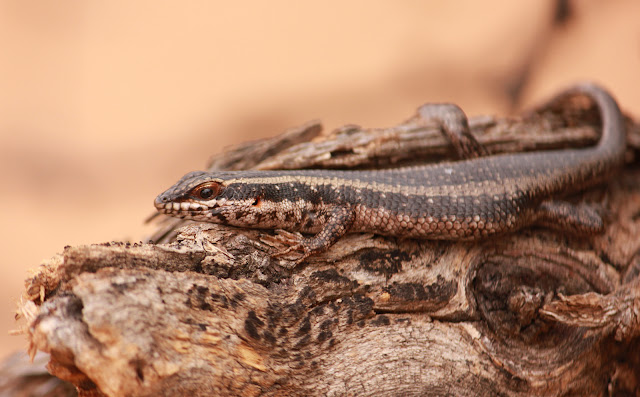 |
| Kalahari Tree Skink - Trachylepis spilogaster, Witsand.
|
 |
Spotted Sandveld Lizard - Nucras intertexta, found dead at night in the veld.
|
 |
Opistophthalmus wahlbergii, Witsand.
|
 |
Giant Ground Gecko - Chondrodactylus angulifer angulifer - Witsand.
|
 |
Opistophthalmus carinatus, Witsand.
|
 |
Cape Wolf Snake - Lycophidion capense capens, Witsand.
|
 |
Parabuthus raudus, Witsand.
|
 |
|
Hottentotta arenaceus, Witsand.
|
 |
| Southern Ground Agama, Agama armata, Witsand. |
 |
| Leopard Tortoise -
Stigmochelys pardalis, Witsand. |
After Witsand we continued our westward trajectory and drove
towards Augrabies National Park. This is a scenic park in a very arid
environment and it is famous for its waterfall were the mighty !Garib (aka
Orange River) is forced through a gap and cascades 56 metres into the gorge
below. The power of the water moving is incredible and it seems to make the
surrounding rocks and cliffs tremble.
 |
| Augrabies Flat Lizard, Platysaurus broadleyi, Augrabies Falls National Park. |
 |
| Desert Scene Augrabies Falls National Park (photo Melissa Petford). |
 |
| Baboons at night, Augrabies Falls National Park. |
 |
Augrabies Gecko, Pachydactylus atorquatus, a beautiful Augrabies endemic.
|
 |
Western Ground Agama, Agama aculeata aculeata, Augrabies Falls National Park.
|
 |
Western Thread Snake, Namibiana occidentalis, Augrabies Falls National Park.
|
 |
| Haake's Gecko - Pachydactylus haakei. Augrabies Falls National Park. |
 |
|
Purcell's Gecko - Pachydactylus purcelli, Augrabies Falls National Park.
|
 |
| Namaqua Mountain Gecko -Pachydactylus montanus, Augrabies Falls National Park. |
 |
| Desert Scene, Augrabies Falls National Park. |
 |
Black Spitting Cobra raiding bird nest, Naja nigricincta woodi, Augrabies.
|
 |
| Springbok, Augrabies Falls National Park (photo Melissa Petford). |
 |
| Nile Monitor,
Varanus niloticus, Augrabies Falls National Park (photo Melissa Petford). |
 |
Spotted Barking Gecko, Ptenopus garrulus maculatus, Augrabies(photo Melissa Petford)..
|
 |
| Western Three-striped Skink, Trachylepis occidentalis, Augrabies Falls National Park.
|
 |
| Plain Sand Lizard - Pedioplanis inornata. Augrabies Falls National Park. |
 |
| Dwarf Plated Lizard,
Cordylosaurus subtessellatus, Augrabies Falls Nationa; Park.
|
 |
| Augrabies Falls - the mighty !Garib channeling through a crack (photo: Melissa Petford). |
Augrabies has some interesting biodiversity – the gorge and
surrounding areas are home to two very interesting lizards – the Augrabies Flat
Lizard and the Augrabies Gecko. The density of the Flat Lizards is astounding.
There are just so many. Augrabies has some interesting walks on top of the gorges. We did a few night
walks and experienced what must have been hundreds of thousands of bats
emerging in the early evening to feast on the mosquitoes, flies and midges
abundant around the river.
 |
| Night Scene: Goegap Nature Reserve, Springbok Region. |
 |
Western Sandvel Lizard, Nucras tessellata, Goegap.
|
 |
| Arid Namaqua Highland Scene, Goegap Nature Reserve. |
The next destination after Augrabies was Springbok and more
specifically the Goegap Nature Reserve outside the town. The area is an
important for it’s unique floral diversity and is part of the Namaqua
Highlands. The nights in the region were cold but we managed to get out and
photograph some interesting animals. Including Brant’s Whistling Rat, Western
Sandveld Lizard and Opistophthalmus peringueyi, one of the burrowing scorpions.
The Springbok area was one of my favourite places on the trip, I will not
hesitate to visit again.
 |
| Gemsbok, Goegap (photo: Melissa Petford). |
 |
Opistophthalmus pallipes, Goegap.
|
 |
Parabuthus schlechteri, Goegap.
|
 |
| Bright Blue Southern Rock Agama, Agama atra, Goegap. |
 |
Quartz Gecko, Pachydactylus latirostris, Goegap.
|
 |
Namaqua Gecko, Pachydactylus namaquensi, Goegap.
|
After Springbok our destination was the Atlantic and we
drove to Port Nolloth. In former times this must have been one of the most
beautiful regions in Southern Africa. The area is arid and the plant life
consists predominantly of small succulents and small hardy shrubs. Plants and
animals in the area derive most of their water from the fog that comes off the
cold Atlantic Ocean. The unique fauna and flora and the area’s natural beauty
has been severely damaged due to the mining of diamonds in the dunes and on the
shore. Large tracts of pristine dunes have been churned up in the search of
these little rocks. Paradoxically there is one advantage to the natural
environment that the mining has brought and that is the protection of land
through strictly controlled restricted access. For some species like the
Namaqua Dwarf Adder (smallest adder in the world) this may contribute to its
protection as the snake is over harvested by poachers. To me it is absurd to
take a little reptile like that out of its natural environment and put into a
small plastic container to live out the rest of its life.
 |
| Sandveld scene: Port Nolloth (Photo: Melissa Petford). |
 |
| Angulate Tortoise,
Chersina angulata, Port Nolloth.
|
 |
| Cape Skink, Trachylepis capensis, Port Nolloth. |
 |
|
Striped Pygmy Gecko - Goggia lineata, Port Nolloth.
|
 |
Giant Desert Lizard, Meroles ctenodactylus, Port Nolloth.
|
 |
| Knox's Desert Lizard, Meroles knoxii, Port Nolloth. |
Despite all the signs of exploitation, Port Nolloth was an
interesting place. We got to walk around in the dunes and caught up with some
interesting lizards, the highlights being the Giant Desert Lizards.
 |
| Desert Scene, Richtersveld National Park. |
 |
| Tenebrionidae feeding on a flower, Richtersveld National Park. |
Having reached our journey’s western limit the next step was
to drive north into the desert and visit the Richtersveld National Park. This
region exhibits the most remote and rugged
landscapes I have ever encountered.
 |
Richtersveld Gecko, Pachydactylus carinatus, Richtersveld National Park.
|
 |
Monica's Gecko, Pachydactylus monicae, Richtersveld National Park.
|
 |
| Uroplectes schlechteri, Richtersveld National Park. |
 |
| Richtersveld Gecko, Pachydactylus carinatus, Richtersveld National Park. |
The desert is brutal and
unforgiving. The only respite from the brutality of the heat and rocks was
being able to swim in the !Garib and walk at night. The natural beauty of this
rocky and mountainous desert landscape was humbling and we were lucky enough to
catch up with some beautiful animals. Including the rarely seen burrowing
scorpion – Opistophthalmus haakei. I will never forget the power of the desert
at the Richtertsveld. The region is completely inhospitable and this is what makes it such a remote
wilderness.
 |
| Parabuthus schlechter, Richtersveld National Park. |
 |
| Opistophthalmus haacke, Richtersveld National Park. |
 |
| Desert Scene: view down drainage line, Richtersveld National Park.. |
 |
| Dassie Rat, Richtersveld National Park. |
Our next and final destination was Aggenys via Springbok.
The plan was to drive at night and sleep in the car on the way in search of
nocturnal animals and what a successful night we had. We encountered some very
interesting and charismatic reptiles (two live Coral Snakes and a Tiger Snake)
as well as a few scorpions including: Opistophthalmus granicauda; Opistophthalmus
peringueyi; Parabuthus granulatus. At about two in the morning we called it a
day and found a nice little granite quarry to rest in.
 |
| Parabuthus capensis, near Spektakal Pass. |
 |
| Opistophthalmus granicauda, near Spektakal Pass. |
 |
| Opistophthalmus peringueyi, near Spektakal Pass. |
 |
| Parabuthus granulatus, Springbok area. |
 |
| Second live Cape Coral Snake, Aspidelaps lubricus lubricus, in a night. Near Springbok. |
 |
| Beetz's Tiger Snake, Telescopus beetzii, near Springbok. |
 |
|
Giant Ground Gecko, Chondrodactylus angulifer angulifer, Springbok.
|
 |
| Karoo Toad, Vandijkophrynus gariepensis, near Spektakal Pass. |
Waking up after a night sleeping in the car it was off to
the final destination, Aggenys in the hope of seeing some interesting scorpions
and reptiles. And what a treat there was in store for us. Hoping to see the
giant scorpion, Opistophthalmus gigas we were rewarded with what most people
would call an infestation of scorpions. This huge species was everywhere.
 |
| Namakwaland scene, near Aggenys. |
 |
| Opistophthalmus gigas, near Aggenys. |
 |
| Opistophthalmus gigas infestation: Exhibit one. |
 |
| Opistophthalmus gigas infestation: Exhibit two. |
 |
| Delalande's Beaked Blind Snake, Rhinotyphlops lalandei, near Aggenys. |
 |
| Southwestern Shovel-snout, Prosymna frontalis, near Aggenys. |
 |
| Common Egg-eater, Dasypeltis scabra, near Aggenys. |
 |
| Parabuthus granulatus, near Aggenys. |
Aggenys was a nice wind down after our busy trip. We took
night walks every night and just enjoyed the scenery, unique flora and the
atmosphere of the region. Some reptilian highlights were seeing Good’s Gecko and
also a South-Western Shovel Snout.
We saw so much beautiful and unique biodiversity. The amount
of birds, mammals, reptiles and scorpions we encountered and the spaces we
drove through and stayed in made this trip one of the most memorable I have
ever had the privilege of doing.
Lists
 |
| Richtersveld Gecko, Pachydactylus carinatus, Richtersveld National Park. |
 |
| DOR Cape Cobra, Naja nivea, near Stienkopf. |
Reptiles 49
Chersina angulata
Stigmochelys pardalis
Chondrodactylus angulifer angulifer
Chondrodactylus bibronii
Chondrodactylus turneri
Goggia lineata
Pachydactylus atorquatus
Pachydactylus carinatus
Pachydactylus goodi
Pachydactylus haackei
Pachydactylus latirostris
Pachydactylus montanus
Pachydactylus monicae
Pachydactylus namaquensis
Pachydactylus purcelli
Ptenopus garrulus maculatus
Meroles ctenodactylus
Meroles knoxii
Nucras intertexta
Nucras tessellata
Pedioplanis inornata
Pedioplanis lineoocellata pulchella
Pedioplanis namaquensis
Karusasaurus polyzonus
Platysaurus broadleyi
Cordylosaurus subtessellatus
Trachylepis capensis
Trachylepis occidentalis
Trachylepis punctatissima
Trachylepis spilogaster
Trachylepis sulcata sulcata
Trachylepis variegata
Varanus albigularis albigularis
Varanus niloticus
Chamaeleo dilepis dilepis
Agama aculeata aculeata
Agama atra
Agama hispida
Rhinotyphlops lalandei
Namibiana occidentalis
Bitis xeropaga
Lycophidion capense capense
Prosymna frontalis
Aspidelaps lubricus lubricus
Naja nigricincta woodi
Naja nivea
Crotaphopeltis hotamboeia
Dasypeltis scabra
Telescopus beetzii
 |
|
Monica's Gecko, Pachydactylus monicae, Richtersveld National Park.
|
 |
Opistophthalmus carinatus, Witsand.
|
 |
| Parabuthus schlechteri, Richtersveld National Park. |
Scorpions 18
Uroplectes schlechteri
Uroplectes sp. (De Hoop 1)
Uroplectes sp. (De Hoop 2)
Parabuthus capensis
Parabuthus granulatus
Parabuthus laevifrons
Parabuthus raudus
Parabuthus schlechteri
Parabuthus sp. (Aggenys)
Hottentotta arenaceus
Opistophthalmus carinatus
Opistophthalmus gigas
Opistophthalmus granicauda
Opistophthalmus haackei
Opistophthalmus lornae
Opistophthalmus pallipes
Opistophthalmus peringueyi
Opistophthalmus wahlbergii
Hadogenes zumpti
 |
| Giant Eagle Owl, Witsand (Photo: Melissa Petford). |
Birds 129
Helmeted Guineafowl
White Faced Duck
Egyptian Goose
Spurwing Gose
Golden Tailed Woodpecker
Ground Woodpecker
Crested Barbet
Acacia Pied Barbet
African Hoopoe
Green Wood-Hoopoe
Common Scimitarbill
Giant Kingfisher
Swallow-tailed Bee-eater
European Bee-eater
White-backed Mousebird
Red-faced Mousebird
Black Cuckoo
Jacobin Cuckoo
Burchells Coucal
Alpine Swift
White-rumped Swift
Little Swift
Palm Swift
Common Swift
Giant Eagle Owl
Spotted Eagle Owl
Cape Eagle Owl
Rufous Cheeked Nightjar
Speckled Pigeon
Laughing Dove
Cape Turtle Dove
Namaqua Dove
Rock Dove
Northern Black Korhaan
Namaqua Sandgrouse
Double Banded Sandgrouse
African Black Oystercatcher
Spotted Thick-knee
Three-banded Plover
White-fronted Plover
Blacksmith Lapwing
Crowned Lapwing
Double-banded Courser
Kelp Gull
Hartlubs Gull
Black Shouldered Kite
African Fish Eagle
Lappet-faced Vulture
Black-chested Snake-eagle
Southern Pale Chanting Goshawk
Jackal Buzzard
Steppe Buzzard
Verreauxs Eagle
Martial Eagle
Rock Kestrel
Greater Kestrel
Amur Falcon
Lanner Falcon
White-breasted Comorant
Cape Comorant
African Darter
Cattle Egret
Black Headed Heron
Hadeda Ibis
Glossy Ibis
African Sacred Ibis
African Spoonbill
Lesser Flamingo
Greater Flamingo
Brubru
Crimson Breasted Shrike
Bokmakierie
Pririt Batis
Cape Crow
Pied Crow
Common Fiscal
Ashy Tit
Rock Martin
Barn Swallow
Lesser Striped Swallow
White-throated Swallow
Red-breasted Swallow
African Red-eyed Bulbul
Long-billed Crombec
Rufous-eared Warbler
Chesnut-vented Tit-babbler
Orange River White-eye
Black-chested Prinia
Rufous -eared Warbler
Rufous Naped Lark
Karoo Long-billed Lark
Cape Long-billed Lark
Barlows Lark
Karoo Thrush
Marico Flycatcher
Fiscal Flycatcher
Fairy Flycatcher
Karoo Scrub-Robin
Kalahari Scrub-Robin
African Stonechat
Familiar Chat
Mountain Wheatear
Ant-eating Chat
Pale-winged Starling
Cape Glossy Starling
European Starling
Common Myna
Southern Double Collared Sunbird
Dusky Sunbird
Sociable Weaver
White-browed Sparrow-Weaver
Scaly-feathered Finch
Southern Masked Weaver
Southern Red Bishop
Yellow Crowned Bishop
Long-tailed Widowbird
Common Waxbill
Pin-tailed Whydah
House Sparrow
Great Sparrow
Cape Sparrow
Southern Grey-Headed Sparrow
African Pied Wagtail
Cape Wagtail
Long-Billed Pipit
Yellow Canary
White-throated Canary
Cape Bunting
 |
| Yellow Mongoose, Witsand (Photo: Melissa Petford). |
 |
| Meercats or suricats, Klienzee (Photo: Melissa Petford). |
Mammals 28
Vervet Monkey
Chacma Baboon
Lesser Bushbaby
Scrub Hare
Rock Rabbit
Spring Hare
Ground Squirrel
Brant’s Whistling Rat
Dassie Rat
Porcupineå
Bat-eared Fox
Black-backed Jackal
Cape Clawless Otter
Striped Polecat
Meercat
Slender Mongoose
Yellow Mongoose
Small Grey Mongoose
Small Spotted Genet
Aardwolf
African Wild Cat
Aardvark
Rock Dassie
Giraffe
Gemsbok
Springbok
Klipspringer
Steenbok
 |
| African Wild Cat, near Goop (Photo: Melissa Petford). |


