keywords

!Garib (2) Acacia karroo (1) afroedura (1) agriculture (1) algae (1) all that crawlith (2) amphibians (3) anthrax (1) aposmatic colouration (2) arachnid (4) arthropod (1) Baobab (3) bat (2) Bat Migration (1) biodiversity (15) bipedalism (1) birds (4) Black Mamba (2) Botswana (1) brumation (1) buffalo (1) Bush Meat (1) bushveld (4) Cambrian (1) Carbon Cycle (1) Central Africa (1) Chameleon (1) chemical erosion (1) coastal forest (1) cocoon (1) coevolution (2) colony (1) conservation (6) consume (1) cosmos (1) cultivation (1) darkling (1) death (3) decomposer (1) Desert (1) Devonian (1) diapsid (2) domestication (1) drought (1) Durban (2) Ecology (9) elapid (2) elephant (1) endemic (2) Energy Cycle (1) eugene marais (2) evolution (2) eye spots (1) fire (2) flash colouration (1) flat dog (1) flower (1) Forest (1) Forest Cobra (1) frog (3) fungus (1) gecko (3) Gondwana (1) Grass (3) herpetology (3) hibernation (1) human culture (8) hyrax (2) identification (3) imago (1) impact crater (1) Inanda (1) Inquiline (1) insect (5) Johannesburg (6) Kalahari (1) Kasanka (1) katydid (3) Klipriviersberg (2) koppies (1) Lajuma (1) larva (1) Leopard (1) Lepidoptera (1) Limpopo (3) Limpopo Valley (1) lowveld (2) Medike Mountain Sanctuary (3) meteorite (1) mimicry (5) mining (2) Miombo (1) mite (1) money (1) moult (1) naja annulifera (1) Namakwa (2) namaqualand (1) natural history (2) nature (7) Neolithic (1) neurotoxic (1) Nietzsche (1) nocturnal (2) Northern Cape (1) nutrient cycle (2) Owl (1) Pafuri (1) Paleoanthropology (1) parasite (2) parasitic (1) pathogenic (1) photosynthesis (1) pioneer (1) Poaching (1) poisoning (1) pollination (1) Predetor and Primate Project (1) raptor (1) reptile (5) reptiles (6) Richtersveld (1) rust (1) savanna (6) scorpion (4) Scorpions (1) selati river (1) skink (1) Snake (7) Snake Snake Snake (2) snouted cobra (1) solifuge (2) South Africa (1) southern africa (1) Soutpansberg (4) Soutpansberg Centre for Biodiversity and Conservation (3) spider (3) spoor (1) spore (1) stone age (1) stridulate (2) Suikerbosrand (1) summer (3) swarm (2) taxonomy (1) Urban Birds Johannesburg (3) Urban ecology (4) Urban Forest (2) Vachellia karroo (1) Vachellia robusta (1) Vachellia xanthophloea (1) Venda (1) venom (1) venus (1) Vhembe Biosphere Reserve (4) waterberg mountains (2) weathering (1) weeds (1) Welgevonden (1) wetland (2) Wheat (1) winter (2) Zambia (1) zoonotic (1)

Blog Archive

Showing posts with label reptile. Show all posts

Wednesday, September 27, 2017

Dream Landscapes: Goegap Nature Reserve, Northern Cape, South Africa


Aloe dichotoma, a symbolic Namakwaland species. Photo Melissa Petford.
In January 2016 I visited the Northern Cape for the first time. One of the places I visited was Goegap near Springbok, spending about three days in the area. I was impressed by the landscapes and biodiversity of the region. I was given another opportunity to visit Goegap during the last week of September 2017, this time for a week. Our objective was to help wildlife film makers, Henk Ekermans and Barend van der Watt, find and shoot some of the smaller animals of this biodiversity rich ecosystem.

Mountain scene with granite boulders at Goegap. Photo Melissa Petford.
Hot arid gravel plain. At night these come alive with geckos and scorpions.
A lone Aloe dichotoma growing on slope.
After a long trip from the Soutpansberg in Northern Limpopo Province, we drove to Springbok and enjoyed the transition from Savannah to Highveld to Kalahari to Nama Karoo, once again reminded me of the vastness of South Africa and all the wide open spaces left.

Many-horned Adder (Bitis cornuta) we were lucky enough to see. A definite reptilian highlight of the trip.
Some colour. Western Sandveld Lizard (Nucras tessellata) found foraging among the plants.
We were lucky enough to have access to many inaccessible areas of the reserve and given permission to travel freely even at night. This allowed us, despite the cold dry weather, to find many interesting reptiles, arachnids and centipedes while being immersed in dream like landscapes. A big attraction to the area this time of year is the Namaqualand flowering period. Unfortunately the rains did not arrive this year so the flowers were few and far between, still we saw some amazing plants.

Interesting quartz outcrop.
Quartz outcrop among granite hills.

We were quite lucky with our reptiles and wracked up a nice species tally with a few we had never seen before. Our totals in the end were 32 reptiles; with seven snakes, 23 lizards, 2 tortoises (shells only). The list is as follows:

Snakes
Beetz’s Tiger Snake (Telescopus beetzii)
Brown House Snake (Boaedon capensis)
Mole Snake (Pseudoaspis cana) – DOR 
Karoo Sand Snake (Psammophis notostictus)
Fork-marked Sand Snake (Psammophis trinasalis) – DOR
Delandes Beaked Blindsnake (Rhinotyphlops lalandei)
Many-horned Adder (Bitis cornuta)

Lizards

Geckos
Weber’s Gecko (Pachydactylus weberi)
Barnard’s Gecko (Pachydactylus barnardi)
Quartz Gecko (Pachydactylus latirostris)
Large-scaled Gecko (Pachydactylus macrolepis)
Namaqua Gecko(Pachydactylus namaquensis)
Giant Ground Gecko (Chondrodactylus  angulifer angulifer)
Bibron’s Gecko (Chondrodactylus bibronii)
Spotted Barking Gecko (Ptenopus garrulous maculatus)
Namaqua Pygmy Gecko (Goggia rupicola)
Namaqua Flat Gecko (Afroedura africana namaquensis)

Lacertids
Spotted Desert Lizard (Meroles suborbitalis)
Plain Sand Lizard (Pedioplanis inornata)
Namaqua Sand Lizard (Pedioplanis namaquensis)
Western Sandveld Lizard (Nucras tessellata)

Cordylids
Karoo Girdled Lizard (Karusasaurus polyzonus)
Cape Flat Lizard (Platysaurus capensis)

Gerrhosaurs
Dwarf Plated Lizard (Cordylosaurus subtessellatus)

Skinks
Cape Skink (Trachylepis capensis)
Western Three Striped Skink (Trachylepis occidentalis)
Western Rock Skink (Trachylepis sulcata)
Varigated Skink (Trachylepis variegata)
Striped Dwarf Legless Skink (Acontias lineatus)

Agamid
Southern Rock Agama (Agama atra)

Tortoises
Angulate Tortoise (Chersina angulate)
Speckled Padlooper (Homopus signatus)
Our first snake, Beetz's Tiger Snake, Telescopus beetzii. Beautiful and colourful.
The Namakwa form of the Brown House Snake (Boaedon capensis). Bug-eyed and very pale. Was really hoping to see one.
Detail of above Brown House Snake (Boaedon capensis). Look at those eyes!
Second Brown House Snake (Boaedon capensis). This female was large and more beautiful than the first.
Delandes Beaked Blind Snake (Rhinotyphlops lalandei). Detail of the business end. Photo Melissa Petford.
Saw several of these Karoo Sand Snakes (Psammophis notostictus). Graceful and difficult to detect.
Karoo Sand Snakes (Psammophis notostictus) full body shot.
Detail of the head of Many-horned Adder (Bitis cornuta).
Many-horned Adder (Bitis cornuta) a master of camouflage in it's complex environment.
Namaqua Gecko (Pachydactylus namaquensis). Common gecko in massive granite outcrops.
A juvenile Pachydactylus barnardi. Amazing little animal.
Large-scaled Gecko (Pachydactylus macrolepis), one of our most exciting gecko finds.
Dorsal view of Large-scaled Gecko (Pachydactylus macrolepis) showing banding.
Spotted Barking Gecko (Ptenopus garrulous maculatus). Common as muck, but very difficult to capture.
Weber’s Gecko (Pachydactylus weberi). Fast little geckos found on rocky outcrops.
Quartz Gecko (Pachydactylus latirostris). The most abundant reptile of Goegap. At night their soft calls filled the air.

Namaqua Pygmy Gecko (Goggia rupicola). Tiny psychedelic geckos.

Detail of Western Sandveld Lizard (Nucras tessellata) displaying powerful claws and jaws.

Western Sandveld Lizard (Nucras tessellata). Exquisite!
Namaqua Sand Lizard (Pedioplanis namaquensis). We found this guy at night.
Cape Flat Lizard (Platysaurus capensis). These guys are stunning!
Very common in the area, here is a light Karoo Girdled Lizard (Karusasaurus polyzonus).
Karoo Girdled Lizard (Karusasaurus polyzonus), dark form.
Bronzy male Western Rock Skink (Trachylepis sulcata).
A little Varigated Skink (Trachylepis variegata). These delightful little lizards are everywhere.
Another reptilian H\highlight. Striped Dwarf Legless Skink (Acontias lineatus).
Southern Rock Agama (Agama atra). The specimens in the Northern Cape are really massive compared to other populations.

Scorpions

Besides the reptiles, which were good, the Northern Cape region is also an arachnid hotspot. Anyone that knows me knows I love scorps and here are a few of the amazing scorpions and centipeds we found along the way.

Uroplectes gracilor
Parabuthus capensis
Parbuthus shlechteri
Parabuthus granulatus
Opistophthalmus granifrons
Opistophthalmus peringueyi
Opistophthalmus pallipes
Hadogenes phylodes

Parabuthus granulatus
Parbuthus shlechteri

Opistophthalmus granifrons.
Opistophthalmus peringueyi


Centipedes
A nightmare to identify! But we try: Ethmostigmus sp and Scolonependera mortisans

The most beautiful Scolonependera mortisans I have seen.
A large and scary Ethmostigmus
Harpactira namaquensis. A beautiful Baboon Spider.

Overall we had an amazing week, we saw and experienced so much biodiversity. Working and living close to another river system (Limpopo) on the opposite side of the continent, experiencing the !Garib system and all it’s different animals, plants, climatic conditions is such a privilege. Many thanks to Barend and Henk for the opportunity and making our stay extra comfortable.

Louse Fly biting!

Saturday, March 1, 2014

Jeppe – Inner-city Johannesburg Biodiversity


Photos generously supplied by Francis Burger.

A Garden Orb-web Spider (Argiope australis). This spider was capitalising on the many flies of the city.


When I think of a city urban space in Johannesburg, I see concrete, tar roads, steel and a lot dirt, filth and stagnant water. The life I would associate with these spaces would consist of street trees (sterile imports from the northern hemisphere), Pigeons (properly Columbo livia, a cosmopolitan species from the northern hemisphere), the odd house sparrow, rats and cockroaches (all three also imports from the northern hemisphere. My skepticism concerning the ability of nature to be robust enough to not only cling on in the city, but actually thrive, was challenged this February while working with artist Francis Burger on a project working in the city exploring biodiversity. 

A sidewalk and a verge in Jeppe. All available land is used by vegetative life. The competition for space on the verge is evident by the density of the growth. Some plants have taken to growing in the gaps in the asphalt and tar.


This small beetle was found on some grass growing on the verge. Even the smallest areas should not be underestimated as habitats for organisms.

During two qualitative sessions, we walked the streets and explores empty lots between buildings to try and build up an as comprehensive species list, kind of like a snapshot, of what is out there in the city. Our idea at first was to concentrate on grasses, but we soon found ourselves unable to ignore the rich forb diversity. As we progressed we added insects and birds as well as a reptile. After reviewing the findings I really had to face up to my prejudices of what I thought these kinds of environments are able to support.


Three species of beetles from the Coccinellinae sub-family. Many of these beetles are predatory and eat aphids.
Astylus atromaculatus – Spotted Maize Beetle. Native to South America this is a major agricultural pest.

Grass
Johannesburg is often referred to as the largest man-made forest in the world. Many trees were planted in the early days of the city for mining timber. The forest is here and it has changed the environment. In many ways it is a good thing, but Johannesburg should actually be grassland. This can be seen wherever trees and land has been cleared; the grass just comes up.

Inflorescence of Hyparrhenia hirta. An important grass for thatching. Some people were busy harvesting the very grass pictured here.
Chloris pycnothrix or Spider-web Grass.
Eragrostis curvula.
 One of the most amazing things about the growth of grass in the city is that it tries to colonise any bit of ground it gets its seeds into. Grass was found growing on pavements, between the pavers and in some areas in the middle of the road. The ecological role of grass as a weathering agent can clearly be seen. Everywhere it appears to be forcing cracks in the surface of the city open for more plants to get in and continue the process. 
Grass growing in the road. This grass will increase the gap that is already present and allow more organisms a space in what was once an inhabitable surface.

Aliens vegetation and their ecological roles

Cannabis sativa and  Amaranthus hybridus. Both of these plants are important in human culture. Here they are playing the role of pioneer species.
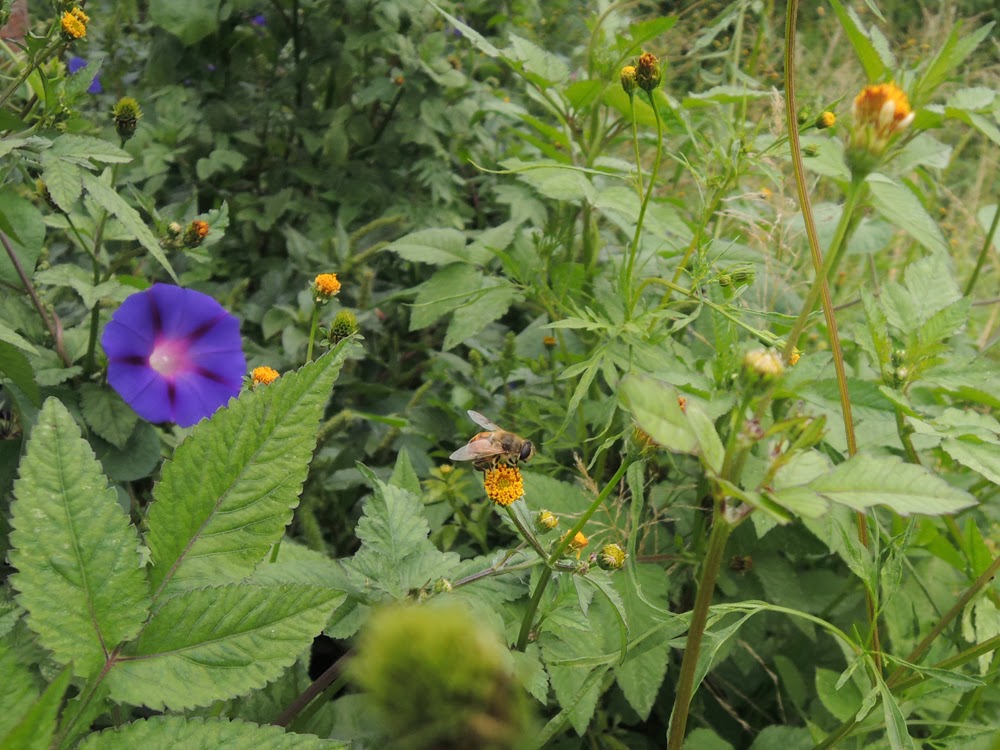
Here there are three dominant pioneer species: Bidens pilosa (Black Jacks), Tagetes minuta (Khaki Bos) and Ipomoea purpurea (Morning Glory).
 Wherever one looks in the city, the ratio between indigenous plants and alien plants is skewed in favour of the aliens. This is to be expected as these alien plants are supported by human activities and they are among the most robust plants out there. These aliens are often found growing in very trying conditions and usually unaffected by parasites and natural enemies as they have evolved in a different ecological climate. In addition to these factors the alien plants that are dominating growth areas are usually very fast growing and spread very easily. 

Cuscuta sp. – Dodder is a fascinating, yet very destructive weed. The plant is parasitic and wraps itself around other plants while disconnecting itself from the ground and feeding directly off its hosts. The plant is yellow and this is because it does not even produce its own chlorophyll for photosynthesis.
Bidens pilosa and Ipomoea purpurea, two South American species growing together.
Even though many of these plants are hated and seen as weeds that need to be eradicated, they do serve a very important purpose in the greater ecological scheme of things: these are the pioneers. This means they are the first plants to colonise a piece of land that has been disturbed. They often have roots that have nitrogen-fixing bacterial nodes on them and these strengthen the soil. The pioneer species make way for secondary succession to take place and after a few years their numbers will decline and different plants will replace them. In the case of what was observed in Johannesburg, the pioneers were mostly Tagetes minuta (Khaki Bos) and Bidens pilosa (Black Jack).


Trachylepis punctatissima – Speckled Rock Skink basking.
Lizards!
I was very pleased to find reptiles in the city. These were represented by Speckled Rock Skinks (Trachylepis punctatissima). These skinks are very robust and indicate that there is not an overuse of insecticides and they also indicate a low population of cats, which usually decimate their populations. At least eleven individuals were observed and there may be as many as triple that amount that was not seen. 

Another Speckled Rock Skink, this one is resting on a strange arrangement of bricks and wire suspended from the ground.

Birds
Birds are a good indication of the state of an environment. This is because they are not restricted by barriers that are faced by terrestrial animals, they can leave and enter areas as they need to. Although the amount of birds in the area is very low, it was higher than I had expected it to be. But when compared to a preserved site in the same city, the species diversity is very low. In the Klipriviersberg Nature Reserve for example, I could get a list of 50 birds on an average day, my list for Jeppe for was 14 birds and some fly-overs. Below is the bird list in order of recording:

Tawny-flanked Prinia, Grey Go-away Bird, Cape Turtle Dove, Laughing Dove, Speckled Pigeon, Rock Dove, Indian Myna, Cape Glossy Starling, Cape Sparrow, House Sparrow, Karroo Thrush, Village Weaver, Grey Heron (fly-over), Green Wood-hoopoe, White Stork (fly-over), Reed Cormorant (fly-over), Barn Swallow and Little Swift.

Rats and beetles 

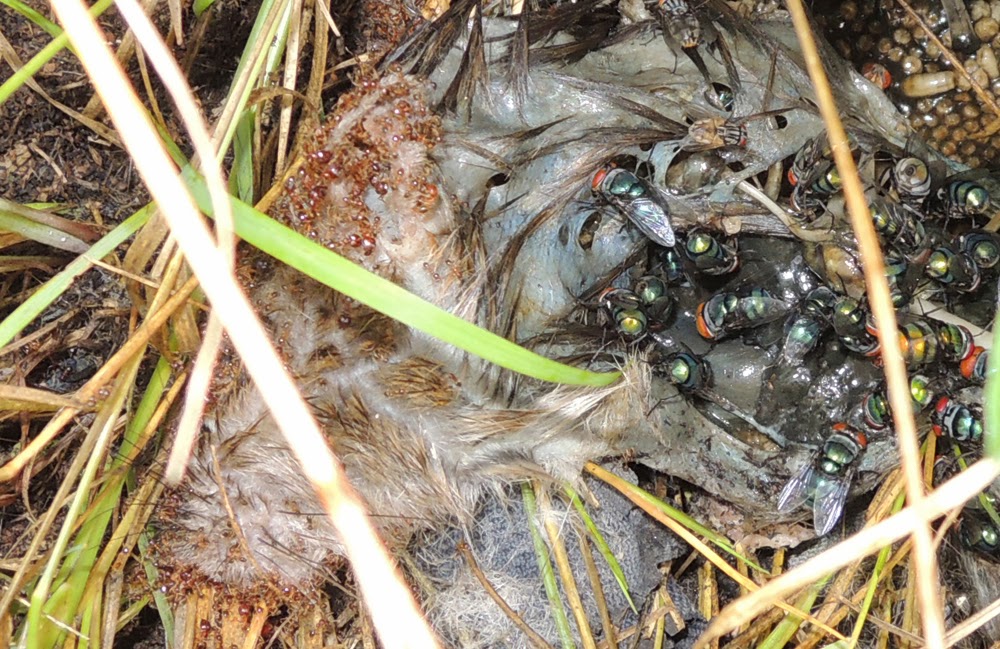
Walking in town and looking in the growth of pavements and in gutters for signs of life one finds many dead rats. In any city rats are very successful and Johannesburg is no exception. Everywhere there were rat corpses in various stages of decomposition, most of them poisoned and some killed in the road by vehicles (although being killed by a car could be indirectly linked to being poisoned as the toxins often change the rats behaviors making them more susceptible to being ‘caught out’ in the open.

The investigation of the rat’s decomposing corpses revealed an ecosystem on a small scale. Dermestidae beetles were found on the bodies and so were flies (Calliphoridae) and their larvae. Feeding on the larvae were hister beetles (Histeridae). The smell of bacteria was also present. These organisms fulfill a very important role in the decomposition process. Most people become queasy when confronted with a carcass blooming with flies and maggots, but if those people could imagine a world without flies and maggots they would feel far more sick.


Looking at how these species are able to survive in what would seem to be adverse situations, I cant imagine what kind of animals would be able to live in a city that provides some kind of ecological support structures. Imagine rooftop gardens with locally indigenous plants, massive containers with grass growing in them and ponds. My vision is one of islands of natural vegetation where insects and birds can flourish. The amount of diversity that can be attracted in such a scenario would be astounding. We are a long way from that vision, but I feel the first step in that direction is to become more aware of locally indigenous life and try and cultivate plants that are locally indigenous to encourage organisms to make our cities their homes too.