keywords

!Garib (2) Acacia karroo (1) afroedura (1) agriculture (1) algae (1) all that crawlith (2) amphibians (3) anthrax (1) aposmatic colouration (2) arachnid (4) arthropod (1) Baobab (3) bat (2) Bat Migration (1) biodiversity (15) bipedalism (1) birds (4) Black Mamba (2) Botswana (1) brumation (1) buffalo (1) Bush Meat (1) bushveld (4) Cambrian (1) Carbon Cycle (1) Central Africa (1) Chameleon (1) chemical erosion (1) coastal forest (1) cocoon (1) coevolution (2) colony (1) conservation (6) consume (1) cosmos (1) cultivation (1) darkling (1) death (3) decomposer (1) Desert (1) Devonian (1) diapsid (2) domestication (1) drought (1) Durban (2) Ecology (9) elapid (2) elephant (1) endemic (2) Energy Cycle (1) eugene marais (2) evolution (2) eye spots (1) fire (2) flash colouration (1) flat dog (1) flower (1) Forest (1) Forest Cobra (1) frog (3) fungus (1) gecko (3) Gondwana (1) Grass (3) herpetology (3) hibernation (1) human culture (8) hyrax (2) identification (3) imago (1) impact crater (1) Inanda (1) Inquiline (1) insect (5) Johannesburg (6) Kalahari (1) Kasanka (1) katydid (3) Klipriviersberg (2) koppies (1) Lajuma (1) larva (1) Leopard (1) Lepidoptera (1) Limpopo (3) Limpopo Valley (1) lowveld (2) Medike Mountain Sanctuary (3) meteorite (1) mimicry (5) mining (2) Miombo (1) mite (1) money (1) moult (1) naja annulifera (1) Namakwa (2) namaqualand (1) natural history (2) nature (7) Neolithic (1) neurotoxic (1) Nietzsche (1) nocturnal (2) Northern Cape (1) nutrient cycle (2) Owl (1) Pafuri (1) Paleoanthropology (1) parasite (2) parasitic (1) pathogenic (1) photosynthesis (1) pioneer (1) Poaching (1) poisoning (1) pollination (1) Predetor and Primate Project (1) raptor (1) reptile (5) reptiles (6) Richtersveld (1) rust (1) savanna (6) scorpion (4) Scorpions (1) selati river (1) skink (1) Snake (7) Snake Snake Snake (2) snouted cobra (1) solifuge (2) South Africa (1) southern africa (1) Soutpansberg (4) Soutpansberg Centre for Biodiversity and Conservation (3) spider (3) spoor (1) spore (1) stone age (1) stridulate (2) Suikerbosrand (1) summer (3) swarm (2) taxonomy (1) Urban Birds Johannesburg (3) Urban ecology (4) Urban Forest (2) Vachellia karroo (1) Vachellia robusta (1) Vachellia xanthophloea (1) Venda (1) venom (1) venus (1) Vhembe Biosphere Reserve (4) waterberg mountains (2) weathering (1) weeds (1) Welgevonden (1) wetland (2) Wheat (1) winter (2) Zambia (1) zoonotic (1)

Blog Archive

Wednesday, October 16, 2013

Arachnids: primeval survivors of an ever-changing world


Under ultraviolet light scorpions fluoresce. It is not well understood why they do this.
With their origins tied deep into the ancient oceans of the Cambrian, arachnids have come a long way. Modern arachnids have diversified into many different families. Most people are familiar with at least some: spiders, scorpions, ticks and mites. Some people have never even seen others like the psuedoscorpions and some are just grouped with spiders with people not seeing the uniqueness of families like solifuges and harvesters.

Gasteracantha, also known as a kite spider. These spiders can reach phenomenal densities in wooded areas, the amount of insects that are caught per day in an area of a square kilometer must be astounding.

The arachnids are invertebrates that belong to the phylum Arthropoda and the sub-phylum Cheliceriformes which includes horseshoe crabs, spiders, ticks, mites, scorpions, solifuges and other groups that are not as well known. The sub-phylum Cheliceriformes once had a member known as Pterygotus buffaloensis which attained a length of close to three meters. This now extinct animal used to inhabit the oceans, in fact this is where the phylum has its origins, the ancient oceans of the Cambrian. [i] That points to an emergence about 485 million years ago. Today the majority of the sub-phylum Cheliceriformes are terrestrial in habits. The aquatic forms include sea-spider and horseshoe crabs. On land the Cheliceriformes have adapted to many situations and lifestyles and there are many families.

Two Uroplectes triangulifer, these small scorpions are very common in the veld around Johannesburg.

Platyoides also known as scorpion spiders are bizarrely shaped, an adaption for living under bark and stones.

Just to give you an idea of  diversity of the phylum chelicerata there are estimated to be  “7,000 well-identified species of air-breathing chelicerates, and there may be about 500,000 unidentified species”. [ii] This kind of diversity is only rivaled by the Hexapoda (insects and their close relations).  There is just so much out there.

Platythomisus, a bright coloured spider that has made its retreat amongst some dead blades of grass.
Anyphops, Flat Wall Spider or flatties as the are sometimes affectionately called are always a nice surprise to find under rocks or in the house. They are able to run forwards or sideways very quickly.

With this post I’d like to introduce those that are unfamiliar with arachnids to these amazing creatures and to those who are already familiar with them I hope you can enjoy the pictures. I will look exclusively at arachnids here, starting with the most familiar arachnids – spiders.

 
Ceratogyrus darlingi, the Rear Horned Baboon spider. These spiders get relatively big and when found moving around at night like this one, it is often a male in search of a female. When he finds a female, he will perform a complicated courtship ritual that involves drumming and touch, she will then allow him to mate with her. He may or may not be consumed by the female, but he is doomed to die anyway. Once he has mated he will not feed again and will not live very long. Male baboon spiders do not live as long as females which are able to live up to 15 years.
 
Stegodyphus, a small spider that has adapted to live in a community made up of others of the same species. Most spiders are solitary, but these Community Nest Spiders are one of the handful of species that are not.
The "nest" of the  Community Nest Spiders is built up overtime and they tend to accumulate the exoskeletons of their consumed prey.
There is some ambiguity as to when exactly spiders emerged, some estimates say about 400 million years ago but small soft bodied arthropods are not easily fossilized. The oldest fossil of a spider is from 374 million years ago and is called Attercopus fimbriunguis, and it is said that when the fossil was being cleaned and prepared a silken thread was still attached to the spinnerets. [iii]

Idiops, a large Trap-door Spider. These spiders are considered to be closer to primitive spiders in shape and habits than those that build webs. It is important to remember that they are not actually primitive in anyway.

Today spiders are commonly split into two groups. The Mygalomorphae (usually live in silk-lined burrows or other retreats) and Araneomorphae (web spinners). The Mygalomorphae include New World Tarantulas, Bird-eaters and Baboon Spiders.  Araneomorphae are considered more modern and are far less limited in where they can live. Members of the Areneomorphae are commonly found in houses and have colonized the entire world except for the continent of Antarctica. 

Scytodes, the Spitting Spider is unusual among spiders and only has six eyes rather than eight. They use a sticky glue type of venom to catch their prey. In this image the sticky venom can be seen in the spiders jaws.
One of the reasons spiders have been so successful is through the ability to produce silk and spin webs. This allowed them to exploit a biological niche and capture insects that had begun to take flight. A theory on the development of web spinning is outlined in Leroy and Leroy’s Spiderwatch:

“Webs might have developed from silken lines that radiated from the mouths of burrows or retreats, which these early spiders, like their modern counterparts, probably laid down as they moved around. These silken trails would have been similar to the slime trails of slugs and snails, and could have enabled them to find their way around and, because they probably contained pheromones, to recognize one another by scent. At the same time, they might have snared crawling insects and, as the millennia passed, the spiders with the most elaborate and efficient silk trails would have caught more insects, eaten better, bred more successfully and evolved increasingly more efficient webs” (11-12).

It is interesting to think of the spider’s web as an extension of its sensory organs and not just as a device for capturing its prey. When the spider sits on its web in anticipation of potential insect prey it is spreads its senses over the entire area the web covers and is made immediately aware when something is caught in the web, from the impact it can tell the size and even the location in the web were the impact occurred. 

Nephila senegalensis, the Golden orb-webbed spider feeding on a locust she has caught in her web. On the ventral side of the spiders abdomen is the tiny male. It is waiting to eat some of what the huge female has caught. These spiders can produce more than 300 meters of silk daily and their webs are strong enough to catch small birds, which the spider will proceed to eat like any other meal they catch in their web.


Silk in spiders is produced as a liquid in the cells of the silk glands. The liquid silk changes to a solid form as soon as it is pulled out from the spinnerets. Spiders can produce a lot of silk in short periods of time. The Golden Orb Web Spiders (Nephila species) can produce more than 300 metres of silk per day. [iv] Spiders also recycle silk by eating it and it has been found that 80-90% of an old web is reused in new webs. [v]

Mexcala, the ant mimicking jumping spider does a good impression of an ant. They have become ant-prey specialists with a prediliction for ants of the species Camponotus cinctellus. To think how this spider came to favour and mimic ants of this specific species is just one of things in nature that bends ones mind.

The next group I would like to look at is a lesser-known group that is often mistaken for spiders. These are the harvestmen or harvesters of the order Opiliones. They superficially resemble spiders and have long legs and a very round body that is not distinctly divided into an abdomen and cephalothorax. These animals are commonly found in leaf litters of forested areas and are not very often seen.  Harvesters are generally predatory and eat mites and aphids, some are scavengers and some eat rotting plant material.

Opiliones, the Harvestman. Over 6 500 species have been described globally. This particular one was photographed in Amsterdam. Picture courtesy of Francis Burger.

The next arachnid order I would like to share is Amblypygi, commonly called whip scorpions but more "correctly" should be called Whip Spiders. These are large flat arthropods get their name from the large sensory “whips” which are sensitive to smell, touch and environmental factors such as heat and humidity. [vi] These whip spiders have powerful modified pedipalps with spines which they use catching their prey which is generally insects and other arthropods, but they have been known to catch small geckos and frogs. [vii]

Damon variegatus, the Whip Spider. These strange looking arachnids can be found in the moister and warmer regions of Southern Africa. In some areas they are very common in dark, moist spaces, sometimes with high densities of individuals inhabiting the same space.

These whip spiders can move suddenly in any direction and their only defense when threatened is to scuttle into the nearest crack. There is something about their creeping movements that unnerves people. They are, like most arachnids, completely harmless and inoffensive and can be handled safely. I have also heard that they make interesting pets.

Pseudoscorpiones are very small arachnids. This individual was photographed in my hand. 
Another overlooked order of arachnids are the Pseudoscorpiones. These are very small and easy to miss. There are said to be around 2 000 species worldwide and 135 species have been found in South Africa. Psuedoscorpions look like scorpions but don’t have a tail. They do have venom though: on the pedipalps (pincers) there is a small joint with venom gland and a “sharp tubular tooth” with which they can inject venom into their prey. The pseudoscorpions prey predominantly on mites and one species Chelifer cancroides has become associated with human dwellings and come to hunt mite and fish moths in book shelves (this is where the common name book scorpion comes from). [viii]

Like scorpions, Pseudoscorpiones have pedipalps modified into pincers. They lack the tail but do possess venom which is located in the modified pedipalps.

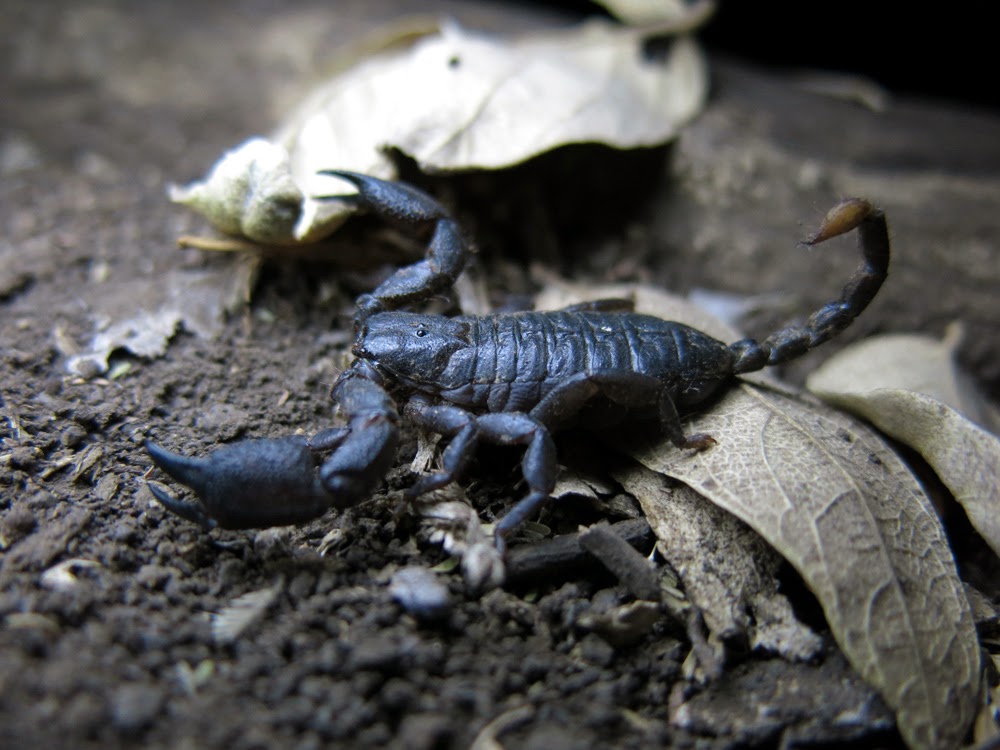
Scorpions are the next order of arachnids I’d like to look at. Southern Africa has a high diversity of scorpions. Of the 1 500 species found worldwide there are said to be more than 130 in Southern Africa. [ix] Scorpions can be found nearly anywhere in Southern Africa and there are three families that occur in South Africa: Buthidae, Ischnuridae and Scorpionidae. Of these, some members of the Buthidae are medically important. 

Opistophthalmus pugnax. These scorpions are a burrowing species and can be found in the veld and koppies around Johannesburg. The name pugnax comes from the Italian word pugno and has combative associations.
Parabuthus transvaalicus, the Transvaal Thick-tailed Scorpion is a formidable creature. Their venom is considered medically important and they are also known to spray venom at attackers. This is a good reason to shake out ones clothing before putting it on in areas where these scorpions occur in high densities.

The Buthidae that are likely to be encountered in Southern Africa come from three genres: Hottentotta, Uroplectes and Parabuthus. These scorpions all have thick tails and small pincers. All individuals from these groups can deliver painful stings and stings from large Parabuthids have resulted in a few deaths. That said, the strength of the venom in these animals is often exaggerated. Many people are stung by full-grown Parabuthus transvaalicus scorpions and although they experience a lot of pain and discomfort suffer no adverse symtoms.

Hottentotta trilineatus, this scorpions are also considered to have very strong venom. A member of this genus from India
Hottentotta tamulus is considered the most lethal scorpion in the world. As with most scorpions, fatalities are usually children and those whose health is compromised in other ways.
Uroplectes flavoviridus.
The Ischnuridae family is represented here by members of the Opisthacanthus and Hadogenes genus. These scorpions are characterized by small tails and large pincers indicating that they have relatively weak venoms and mainly rely on their pincers to overpower prey. These scorpions are generally incredibly docile and reluctant to sting in self-defense.

Hadogenes troglodytes, these are scorpions associated with rocky areas. This species of scorpion can grow up to 21cm long, making it the longest scorpion in the world. They are very docile and inoffensive.
Opisthacanthus, the massive pincers and small tail indicate that this species does not have a potent venom. They are also docile scorpions that tolerate gentle handling.

The Scorpionidae family is represented by one genus in Southern Africa, the endemic Opistophthalmus genus. These are burrowing scorpions and use their powerful pincers to crush their prey. When harassed these scorpions make a hissing sound by “rubbing the stiff bristles on their mouthparts against the underside of their carapace”. [x] These scorpions can deliver painful stings, but are considered harmless. Some species in the genus are very colourful.
 
Opistophthalmus glabrifrons, this large female was moving around at night. She was gravid and very defensive.
Opistophthalmus capensis, this scorpion is in a heightened state of agitation, its pincers are ready to grasp at anything within reach and its venom gland has already begun to secrete a droplet of venom.

Scorpions are one of the few arthropods that actively care for their young. They give birth to live young which emerge from the mothers body one at time and shortly after being born they climb onto the mothers back. The young scorpions stay on their mother’s backs until their first moult, once they have moulted they move away from the mother and make their way into the world on their own, ready to fend for themselves.

Opistophthalmus pugnax with young on her back. It is fascinating to see these animals with their young on their backs. The young are tiny replicas of the adults.
Due to their attractive appearance scorpions have become very popular and many people have developed a keen interest in them. There are special UV torches that can be bought to find scorpions at night and there is a very good reference book available on scorpions called Scorpions of Southern Africa by Jonathan Leeming. There is an initiative that has been created by the Animal Demography Unit at the University of Cape Town called Scorpion Map. This map allows everyday people to upload images of scorpions along with other data onto a database which is beginning to catalogue and map the scorpions of Africa. I recommend that anyone with an interest in scorpions gets involved in this project (see http://vmus.adu.org.za).

These trombidiidae mites are parasites on this scorpion. They attach themselves in a way analogous to ticks on bigger animals.
The next family of arachnids that I’d like to look at are mites and ticks, sub-class Acari. Mites are minute arachnids and 40 000 species have been described globally. It is said that this is probably one tenth of the actual species number so there could be 400 000 species of mites out there. [xi] Mites are everywhere, they are said to exist in densities of millions per square meter “all over the inhabited earth” and “even on our skins there are permanent populations of mites”. [xii]
This large free living mite was photographed in Johannesburg. I have not found a satisfactory identification for it. I assume it is predatory due to its size.
Mites come in so many different forms. There are predatory mites, parasitic mites, mites that feed on plants, and mites that are decomposers. Mites cause some medically important conditions, most notably scabies in humans and mange in animals. The mites pictured here are parasitic mites of the family Trombidiidae. The adult is a large free-living mite.

Trombidiidae or Velvet Mite has attached itself to this gecko. Photograph courtesy of Francis Burger.
Ticks (order Ixodida) are well known because of their ability to infect people and animals with disease. They are blood-sucking parasites and have been around for about 120 million years. [xiii] Ticks have an interesting life cycle, the female lays up to 3 000 eggs. When the larva hatch they climb up the nearest vegetation and wait for passing hosts. I have been host to this stage of tick development and one day pulled over forty tiny ticks from my body. These larva ticks are commonly known as ‘pepper ticks’ due to their small size. Once they have fed and are ready to grow the ticks moult into nymphs and will either reattach to the same host or find a new host. At the next moult they will drop off or reattach, depending on the species. It is through this dropping-off and reattaching to a new host that zoonotic diseases are spread. In southern Africa many diseases are spread by ticks, these include the livestock diseases of Heartwater, Redwater, East-coast fever, Gall fever, African swine pest, Billary and the human diseases Congo fever and Tick-bite fever. 

This Amblyomma tick has attached itself to this tortoise. Big reptiles such as monitors, tortoises and snakes are often host to ticks, sometimes they can become quite infested and their conditions deteriorate.
Although ticks are disliked because of their disease spreading qualities, it must be kept in mind that disease plays an important role in the environment. It strengthens the gene pool by eliminating weaker animals and also kills weaker competitors in times of environmental stress (drought) thus favoring the stronger individuals and thereby strengthening the population.

Diurnal solifuge, this animal paused for a moment long enough for me to get a photograph and was off again. The colours on this species are very striking.
The last group of arachnids I would like to look at, and these are perhaps my favourite group, is the order Solifugae, These are known by various popular names: sun spiders, red romans and even camel spiders (this is a popular name given to these animals by Americans in Iraq, there is a myth that these spiders burrow underground and feed on sleeping camels from below). There are some interesting Afrikaans names for solifuges, the ones that stand out for me are vetvreters (fat eaters) and baardskeerders (beard cutters). [xiv]

This nocturnal solifuge was photographed while consuming a bolus of chewed up invertebrate. One can see the abdomen beginning to become distended, solifuges will gorge themselves until they cannot move, this is the source of the Afrikaans name vetvreter (fat eater).

When looking at a solifuge one is instantly drawn to the size of the jaws. There is a jaw on each side and “each jaw consists of two parts, a solid upper jaw and movable lower jaw, moving past each other like the blades of shears. The large lower jaws house the powerful muscles… Both jaws are equipped with strong chitin teeth”. [xv] 

Solifuges bear a superficial resemblance to spiders, but, amongst other differences, they lack venom glands and the ability to produce silk.
Solifuges move fast and run with their front legs outstretched feeling their way around. They are predatory (although they are known to be scavengers) and gorge themselves when they eat. Solifuges are very active and they are always doing something, making them interesting to watch. I have sat watching them dig holes for a long time, moving like little bulldozers until the hole is very deep. I have also followed hunting solifuges and they seem to never rest, checking every little space for prey items.  Solifuges can also bite humans and the bite can be likened to a powerful pinch, but they are completely harmless to people and their livestock.

Solifuges are covered in sensitive sensory hairs, they use these to detect fluctuations in their environment, especially the movements of potential prey items and the bigger vibrations of predators.
According to Holm and Dippenaar-Schoeman there are 240 species in Southern Africa. There is not much information on these animals available at a popular level, but Holm and Dippenaar-Schoeman (2010) give a good overview of the families that occur locally.  I try to photograph every solifuge I can find and have found them to be incredibly diverse. This is definitely a group I will be looking at more closely in the future.

Solifuges come in a variety of different shapes. This species has a smaller, slimmer build with long legs, perhaps this is an adaption to an arboreal lifestyle.
With this brief overview of arachnids I hope to have inspired some of you to take a closer look at these interesting animals we share this world with. When you see a spider moving across a wall or a tick on your pet, think about how old these creatures are and how long they have been on the earth and how long they will continue here compared to our fleeting stay.


[i] Brusca, R. C and Brusca G. J.  2003. Invertebrates. Sinauer Associates, Inc.: Sunderland (653-654).


[iii] Leroy, A and J. Leroy. 2000. Spiderwatch in Southern Africa. Struik: Cape Town.

[iv] Holm, E and A. Dippenaar-Schoeman. 2010. Goggo Guide: the Arthropods of Southern Africa. Lapa Publishers: Pretoria (158).

[v] Holm, E and A. Dippenaar-Schoeman. 2010. Goggo Guide: the Arthropods of Southern Africa. Lapa Publishers: Pretoria (159).

[vi] Holm, E and A. Dippenaar-Schoeman. 2010. Goggo Guide: the Arthropods of Southern Africa. Lapa Publishers: Pretoria (77).

[vii] Holm, E and A. Dippenaar-Schoeman. 2010. Goggo Guide: the Arthropods of Southern Africa. Lapa Publishers: Pretoria (77).

[viii] Holm, E and A. Dippenaar-Schoeman. 2010. Goggo Guide: the Arthropods of Southern Africa. Lapa Publishers: Pretoria (81-83).

[ix] Leeming, J. 2003. Scorpions of Southern Africa. Struik: Cape Town (42).

[x]  Leeming, J. 2003. Scorpions of Southern Africa. Struik: Cape Town (66).

[xi] Holm, E and A. Dippenaar-Schoeman. 2010. Goggo Guide: the Arthropods of Southern Africa. Lapa Publishers: Pretoria (85).

[xii] Holm, E and A. Dippenaar-Schoeman. 2010. Goggo Guide: the Arthropods of Southern Africa. Lapa Publishers: Pretoria (85).

[xiii] Holm, E and A. Dippenaar-Schoeman. 2010. Goggo Guide: the Arthropods of Southern Africa. Lapa Publishers: Pretoria (103).

[xiv] Holm, E and A. Dippenaar-Schoeman. 2010. Goggo Guide: the Arthropods of Southern Africa. Lapa Publishers: Pretoria (142).


[xv] Holm, E and A. Dippenaar-Schoeman. 2010. Goggo Guide: the Arthropods of Southern Africa. Lapa Publishers: Pretoria (144).

Friday, August 30, 2013

Winter Highlights and the harbingers of Spring 2013


I spent most of the winter in Johannesburg and this year’s weather turned out to be very mild. I spent a lot of time hiking in the Klipriviersberg, occasionally getting out and seeing other places around Johannesburg. Winter in Johannesburg is dry with warm days and cold nights. The sky is blue and the landscape becomes predominately fawn with darker and lighter colours standing out here and there.


A grassland scene from Suikerbosrand just south of Johannesburg.

Due to the generalised diminished activity of life forms in winter, everyday aspects of life begin to attract attention. A plant flowering or a minute crawling arachnid become points of interest that would not be as engaging had they been observed in the bounty offered by summer.
A 'large' free-living predatory mite of the Trombidiidae family. Mites are considered the most diverse group of animals after insects. Over 40 000 species have been described and 2 350 have been recorded in South Africa. 
This Aloe greatheadii var. davyana flowered early in winter. Standing out on the dried out landscape.
Later in the season large areas of the hills were covered in flowering aloes. 


The reason for this floral display: pollination, using insects in the the swapping of genetic material between individual organisms.

When walking in a dry landscape sources of water become a space where life congregates. This slowly moving river in the Suikerbosrand, along the Bokmakierie trail is full of algael life and water plants. The absence of life around the stream draws ones attention to what is happening in the water.


A slow moving stream with algae and water plants, an ecosystem.
Looking closer at the algae in the stream one notices many bubbles that have formed amongst the string like structures of the algae. What is happening is that the algae are photosynthesising. They are turning sunlight into energy and this process of photosynthesis is so important: all the food we eat and all the energy we use (fossil fuels, fire wood etc.) are products of photosynthesis.[1]

Oxygen being released as a waste product from algae.
Looking at a scene like this one can recall the early days of life on earth. Algae and other photosynthesising organisms that inhabited aquatic environments slowly, through bubbling oxygen as waste product, started to create an excess of free oxygen, first in the aquatic environments and then later the atmosphere. The process must have taken millions of years, but in time there was enough oxygen for new oxygen dependent organisms to develop. In time the atmosphere was filled with enough oxygen to allow animal life dependent on oxygen to begin colonising the terrestrial habitats. 


During a cold winters day I took a drive out to a wet land area to the east of Johannesburg called Marievale Nature Reserve. The reserve is in the middle of a rich gold mining area. There are mine dumps on the reserve and the water is no doubt being poisoned slowly through acid mine drainage. Yet there is a lot of life in the reserve. I saw many water birds and even a pair of Large Grey Mongooses (Herpestes ichneumon) which according to the reference material falls outside of their distribution.


A pair of African Fish Eagles (Haliaeetus vocifer) with a mine dump in the background.


Closer view of the African Fish Eagles.
The reserve has many interesting water birds. In the few hours I was there I saw some very interesting species: African Snipe, Cape Shoveler, Red-billed and Hottentot Teals as well as masses of Red-Knobbed Coots and many Little Grebes (Dabchick).
Red-knobbed Coot (Fulica cristata), these birds are very aggressive and dominate most other birds in their home range.
Little Grebe (Tachybabtus ruficollis), a tiny waterbird. Grebes are unique among birds in the habit of swallowing their feathers to prevent injury while regurgitating fish bones and other indigestible material.
In the dry winter landscape, fires often move through large areas, leaving a strange black landscape. In these burnt out areas life continues as the fires are considered cool and they move fast. The damage is often superficial and an important part of the rejuvenation of grassland. In these black patches, even the drabbest birds stand out.


Cape Longclaw (Macronyx capensis) moving through burnt grass looking for insects.

Unlike most mammals the Rock Hyrax or Dassie (Procavia capensis) have little control of their body temperatures and sunbathe and also huddle together at night to keep warm. Hyraxes superficially resemble rodents, but they are from a different order that includes elephants, dugongs and aardvarks. The Hyravoidea family was once one of the dominant herbivores on earth and there were some that grew as large as pigs. With the rise of ungulates the order was unable to compete and now only the smaller forms remain.[2] 


Rock Dassie sunning itself.

In order to take advantage of the rains that may come in spring, many plants begin to flower in winter. This will allow them to drop seed during the early part of the rainy season and ensure that their offspring gets the maximum advantage of a warm wet summer.
Aloe marlothii in flower. Many birds are attracted to the flowers and help pollinate this plant. In the background the suburb of Glenvista is visible. I live in there somewhere.
Ledebouria ovatifolia floweing. These small plants grow close to the ground and flower late in the dry season.
These Moraea stricta flowers are also late winter bloomers.
In anticipation of spring, the Common Wild Pear (Dombeya rotundifolia) produces blossoms.
The Camphor Bush (Tarchonanthus camphoratus) has already flowered and set seed.
This Shield-back Bug (Scutelleridae) nymph has capitalised on the food source provided by the Camphor Bush. It is feeding on the seeds.
On days when there is not much to see, marks in the sand stand out and indicate rich interactions that have taken place unseen.

This porcupine track and dung point to a species that is very rare to see, yet it is a common animal. Porcupines are very secretive and strictly nocturnal.
Lichen slowly grows on rocks. Lichen is a composite organism that is made up of a fungus and an algae. The algae photosynthesises and creates a food source for the algae; the fungus provides moisture and a structure on which the algae can live.


A striking yellow lichen growing on a basalt rock.
Close-up of the lichen, its structure and growth form can be seen. Some lichens slowly chemically erode the substrate they are growing on.
This grey lichen has a more pronounced foliose structure than the yellow form.

Below are some interesting things I saw while walking in different places.


This gum that is being exuded from a Sweet Thorn Tree (Vachellia karroo) is edible and was once marketed as 'Cape Gum'.
This pair of Hadeda Ibises (Bostrychia hagedash) have become such a common sight in suburban Johannesburg, that they seem a little out of place here in their natural habitat. Photographed in the Klipriviersberg Nature Reserve.
Thickbill Weaver (Amblyospiza albifrons subsp. woltersi) perching in reeds at James and Ethel Gray Park in Melrose, Johannesburg. These birds have found a sanctuary in the vegetation around a small dam in the middle of suburbia. Practically, right next to the M1 Highway, one of the busiest roads in South Africa.
Winter is a time of death. Many organisms that are not strong enough succumb to the cold and die. Vegetation dries out and dies back, often fires sweep through areas and burns moribund and kills the weak. This process is important in strengthening populations of organisms.

Even though this process of death is happening all over, life is still strong and the more robust organisms continue to live (at a slower pace) and one does not need to look hard to find life just waiting to for the warmth and rains to return. With the return of warmth come the harbingers of spring. Animals that have been waiting in dormancy for the return of life.


A bat of the Vespertilionidae family foraging in the early evening. Picture taken at the Klipriviersberg Nature Reserve. Bats hibernate for the winter months. Emerging again with the warmth and return of their insect prey.
Summer is returning when reptiles start to emerge from their brumation. Below are the first reptiles of the season.


Cape Centipede Eater (Aparallactus capensis). A specialised feeder which feeds on centipedes which it overpowers with its venom. The snake is completely harmless to humans.
Southern Rock Agama (Agama atra) basks in the sun on it's rock. This lizard will spend the summer defending this rock from up and coming males and mating.
Transvaal Gecko (Pachydactylus affinis). This geckos tail was thin, showing that it used up its fat reserves during the winter. By the end of summer its tail will be good and fat.


[1] For a more detailed discussion of photosynthesis see Van As, J., du Preez, J., Brown, L. and N. Smit. 2012. The Story of Life & The Environment. Struik: Cape Town (131-138).
[2] See Estes, R. D. 1993. The Safari Companion. A Guide to Watching African Mammals. Russel Frieman Books: Halfway House (214- 222).

Wednesday, August 7, 2013

Rust Fungus


Deformity on stem of Vachellia Karroo, caused by Sweet Thorn Rust (Ravenelia macowaniana).
Rust fungi belong to the order Pucciniales and are represented by 540 species (in 40 genera) in Southern Africa and around 7 000 species globally.[1] Despite their prevalence in the environment, rust fungi are generally overlooked in the natural environment. The relationship of rust fungus to the host plant is a pathogenic parasitic relationship. The fungus is an obligate biotroph, meaning that they cannot live outside of their host organisms. Rust fungi exhibit complicated life cycles and some develop five distinct types of spores at the different stages of their life cycles.

Vachellia karroo, normal plant structure. No galls present.
 One of the most widespread species in Southern Africa is Ravenelia macowaniana or Sweet Thorn Rust. This species has all the spore types present in its life cycle. It lives in the Vachellia karroo (Acacia karroo) plant making this species of rust fungus particularly widespread and common. The life cycle of the fungus is complicated.

Ravenelia macowaniana gall. Note the small holes on the gall, these were made by moth larva feeding on the gall.
Summarised from Alan R. Wood, the life cycle can be described as follows:

In the beginning of the growing season, the galls develop on new growth and on these galls “blister-like structures” (pycnia) manifest. These produce minute spores (pycniospores) in a sweet suspension that attracts insects which feed on the substance and spread the spores. This creates a situation of “cross fertilization” and results in “small cup-like aecia [that] are produced all over the galls” and in these asexual spores (aeciospores) are produced which go on to infect the leaflets of the plant. These leaflet infections then initially produce another asexual spore that appears like blisters (uredinia) on the surface of the plant. These uredinia go on to produce urediniospores. Towards the end of the growing season structures called the telia produce the large teliospores which “after overwintering, germinate in the next rain season to begin the cycle again. When germinating these teliospores produce four basidiospores, each of which can infect the new, developing growth producing the [pycnia] galls.”[2]

Ravenelia macowaniana gall. Aecial cups are visible here, indicative of the early parts of the fungus life cycle.

In addition to the fungi and tree relationship, there is a third relationship and that is between the galls and Lepidoptera species (gall moths). There are at least 24 species and they belong to the Tineidae, Oecophoridae, GraciIlariidae, Gelechiidae, Cosmopterigidae, Tortricidae, Pyralidae and Noctuidae families. [3] M. Krüger (1998) groups the moths into three guilds: “putative obligate species, i.e. those feeding on gall tissue … A second significant guild comprises polyphagous species that develop as borers, mostly in fruits and pods of their host plant … The third guild includes species that are probably predators of other larvae” (55–56).  The life history of these moths is, as Krüger himself puts it, “obscure”.  

The obligate species of moths associated with the Ravenelia macowaniana are an example coevolution. That makes the relationship between the tree, the fungus and the moths incredibly old. All three have been evolving together into their current coupling. The tree seems to be relatively defenseless against the rust. I have noticed that trees growing in less than perfect locations exhibit more of the disease. It would be interesting to find out more about the trees defenses against the rust.

Thinking about the intricacies in the relationship between this tree and the fungus that lives inside it and the relationship of the moths to the galls produced by the fungus in collaboration (even though it is through disease) with the tree, just demonstrates that we are surrounded by biodiversity of such a magnificent scale. Just looking at something as small as fungal structures on the surface of tree can reflect relationships and interactions that are not even well understood. In trying to find out what the cause of the structures are; moths and a strange world of fungus is called up. This is the mysterious world of nature that has makes my brain burn with wonder.


[1] For an overview of the taxonomy of the Pucciniales see: http://www.plantmanagementnetwork.org/proceedings/FCRS/2011/Presentations/Aime.pdf

[2] Adapted from Wood, A. R. (2012). Rust fungi on South African plants. Veld & Flora, 3 (98), 123– 125. 


[3] For a discussion of the moths see: Krüger, M. (1998). Identification of the adults of Lepidoptera inhabiting Ravenelia macowaniana Pazschke (Uredinales) galls on Acacia karroo Hayne (Fabaceae) in southern Africa. African Entomology 6, 55–74.

Tuesday, July 16, 2013

Grass: a quiet accomplice


Various species of grass growing together in a grassland area.
Grass has been around for 30 million years. There are 9 700 species of grass of which 967 occur in Southern Africa with 329 endemic species. [1] This makes grass the fourth largest plant family on earth. From a day-to-day perspective the importance of grass to humans is often underestimated. One needs only to think what they ate for breakfast this morning or dinner last night and you will realise that grass is an important part of every meal. Rice, oats, maize, wheat, barley, rye, sugar and more are all grasses and are an important cornerstone of daily diets. Even the animals that we eat are dependent on grass, therefore we are indirectly getting the energy they have converted from the grass. The role of grass in the energy cycle and nutrient cycle is extremely important.

Due to the low growth parts of the plant, grass is able to withstand fire, drought and grazing. Using these destructive forces to gain advantage over other plants growing around it.
Of the grasses the most important in terms of contemporary human culture is the grass we know as wheat. Wheat, a prime agitator of the Neolithic revolution, was first cultivated in the Fertile Crescent at least 10 500 years ago. This ultimately resulted in the success of humans over other species. Wheat enabled humans to spread out and sustainably increase their population densities into Europe and Asia and eventually the entire world. The domestication of grass also led to the domestication of livestock and this further contributed to the success of humans. [2]  
Grassland scene consisting of a few types of grass. There are grasses filling all the niches in the grassland ecosystem. Some are bushy, some grow low to the ground, while some form dense stands.
Today grass is widely cultivated due to human activity. Sugar, maize, rice and wheat are the most commonly cultivated grasses globally. The amount of land that is under the cultivation of these grasses is enormous. The environmental impact and socioeconomic implications of the widespread cultivation of grasses is significant and very interesting to think about. From an ecological perspective it is clear that globally biodiversity is negatively affected because of these crops.
These burnt out trees are testament to a past fire. These trees were over five years old. No longer saplings, yet they succumbed to the flames. 
From the perspective of the grasses however, their success is really astounding. They have, in a sense, managed to use humans to spread globally and colonize land that they would never naturally be able spread to. They managed this trick by offering a high-energy sugar in exchange for worldwide cultivation. The relationships of these grasses to humans can be seen as one of obligate mutualism. Humans would not be able to continue the way they currently live without these grasses and the grasses, such as wheat, rice, maize etc., as they currently exist would not be able to survive without people.

This Aloe will survive the fire damage, its point of growth is well protected by its fleshy leaves and compressed growth form. The Acacia saplings that grow around this aloe have burnt and most will not survive.
Despite getting some help from people, grasses have done very well for themselves. They have been around for about 30 million years. The origin of grass must have been humble: a small plant adapted for dry conditions competing with other desert scrub plants. Over time more species appeared and began to compete with and replace dry woodland areas. About four million years ago grass had begun to produce savanna. [3] Today approximately 40 percent of the earth’s terrestrial surface is covered by grass. The success of grass has to do with the co-evolution of grazing animals, the resistance to frost and the ability of grass to use fire to its advantage as well as the ability of grass to be drought resistant.

Even on rocky hills like this, over time grass will replace the woody plants.
The growing points of grass are low on the plant and these are often below the ground. With other plants, the growth points are above ground and susceptible to fire damage as well as frost damage. Over time fires and frost will eliminate the small trees and shrubs and favour the grasses as dominant on the landscape. Within any grassland system there will be many other plants that are not grasses that are adapted for the hostile conditions of growth created by the grassy cover.

Euphorbia clavarioides is a herbaceous plant adapted to grassland areas. 
Xerophyta retinervis, this is another plant adapted to grassy areas. The stem is fire resistant and can survive sustained drought and spells of frost.
The ability of grass seeds to lay dormant in or on the ground is the way in which grass overcomes the problem of drought. Most trees and shrubs are not drought resistant and over time the grassland will grow and these plants will be displaced. In well established grassland, trees and shrubs often only grow in protected areas and drainage lines.

Some trees are specifically adapted to grassland areas. This Cussonia paniculata has deeply fissured and corky bark. This offers it some resistance to fires and cold. The other trees in the photograph may have survived the fire, but they too will eventually be replaced by grass.

Africa, because of the large areas of grassland and associated savanna is home to 75 different bovids and of these 72 are antelope. This is an incredible diversity. These animals came into existence about 25 million years ago which is well within the era of grass. Even though not all antelope are grazers, they are just an example of the kind of diversity that a rich food source can sustain.   
The Blue Duiker, Cephalophus monticola, one of the smallest antelope. This is a forest species which browses on fallen fruit and leaves. Even though it is not a grazer this species indicates the diversity which has been enhanced by grass.
  
The Eland, Tragelaphus oryx, is the largest antelope. This animal which can way up to 940kg is a major consumer of grass. Even though they do browse, grass makes up a substantial portion of their diet.
On a global level, grass plays a very important role. There is a theory that the expansion of grassland globally has played a role in the cooling of the earth over the last 30 million years. The theory is summed up as follows by McCarthy and Rubidge (2005) in the following way:

Grasslands store far less carbon than forests in actual plant material, but grassland soils are usually far richer in carbon than forest soils, so grasses effectively remove carbon from the atmosphere and store it in soils. This may in part be due to frequent fires, which produce copious charcoal that is not easily decomposed by bacteria and becomes incorporated into the soil. […] Grasslands are much lighter in colour than woodland and they reflect a greater proportion of solar radiation into space, contributing to cooling. The air over grasslands is generally much drier than over woodland because trees tap deep-water sources and pump the water into the atmosphere by transpiration. Water vapour is a powerful greenhouse gas, so more grassland means drier, and thus cooler air. (The Story of Earth and Life. Struik: Cape Town. Page 261.)

This grassland scene captured in the Suikerbosrand Nature Reserve clearly shows how much lighter grassland is compared to woodland. Note how shrubs and trees are limited to protected areas.
The rise of grasslands led to a decline in forests and many animals had to adapt to this change. Grazers emerged and colonized the grasslands and carnivores followed. Human evolution was also significantly affected by the domination of grass plants. Paleoanthropology generally accepts that the ancestors of modern humans left the forests to become savanna creatures, and that this move from forests to the grassy plains was what resulted in bipedalism. [4]

Grass has been an important factor for the emergence of the human being. It played a role in the primordial past when hominids were still finding their legs and it played a major role in the development of modern culture through the early beginnings in the Neolithic period. It has also produced partner animals on which we are reliant and which have also helped humans rise to the point where we now find ourselves. On a global scale, grass may be responsible for cooling our planet and keeping the temperatures at an optimal level. Without grass, humans would not have developed, as the forests would not have receded forcing our distant ancestors to colonize the open areas.


Our culture and biology is so closely tied to grass that the global colonization of the human animal would not have been possible without the domestication of specific species of grass. One thing however is for certain, when humans are long gone, grass will continue to quietly grow and be a powerful source of energy driving biological diversity and sustaining a multitude of organisms.

This harvester termite, Hodotermes, is a major grazer of grassland. Insect consumption of grass is greater than that of mammalian  consumption in natural areas. These termites diets consist of 94% of grass and they can consume 1-3 metric tons of forage per hectare per year. 


[1] van Oudtshoorn, F. 2012.  Guide to Grasses of southern Africa. Briza: Pretoria. Page 10.

[2] For a more detailed and very stimulating discussion of the role of wheat in human culture see Jared Diamond’s book Guns, Germs and Steel.

[3] McCarthy, T and Rubidge, B. 2005. The Story of Earth and Life. Struik: Cape Town. Page 261.


[4] Anyone can try a simple experiment to see that advantages of bipedalism first hand. Next time you are in a grassland environment, when surrounded by long grass, go down on your hands and feet and see how different the environment is from down there. The adaption of standing on ones rear feet provides security as well as a vantage point from which one can see the surrounding environment, thus contributing to the success of the species.